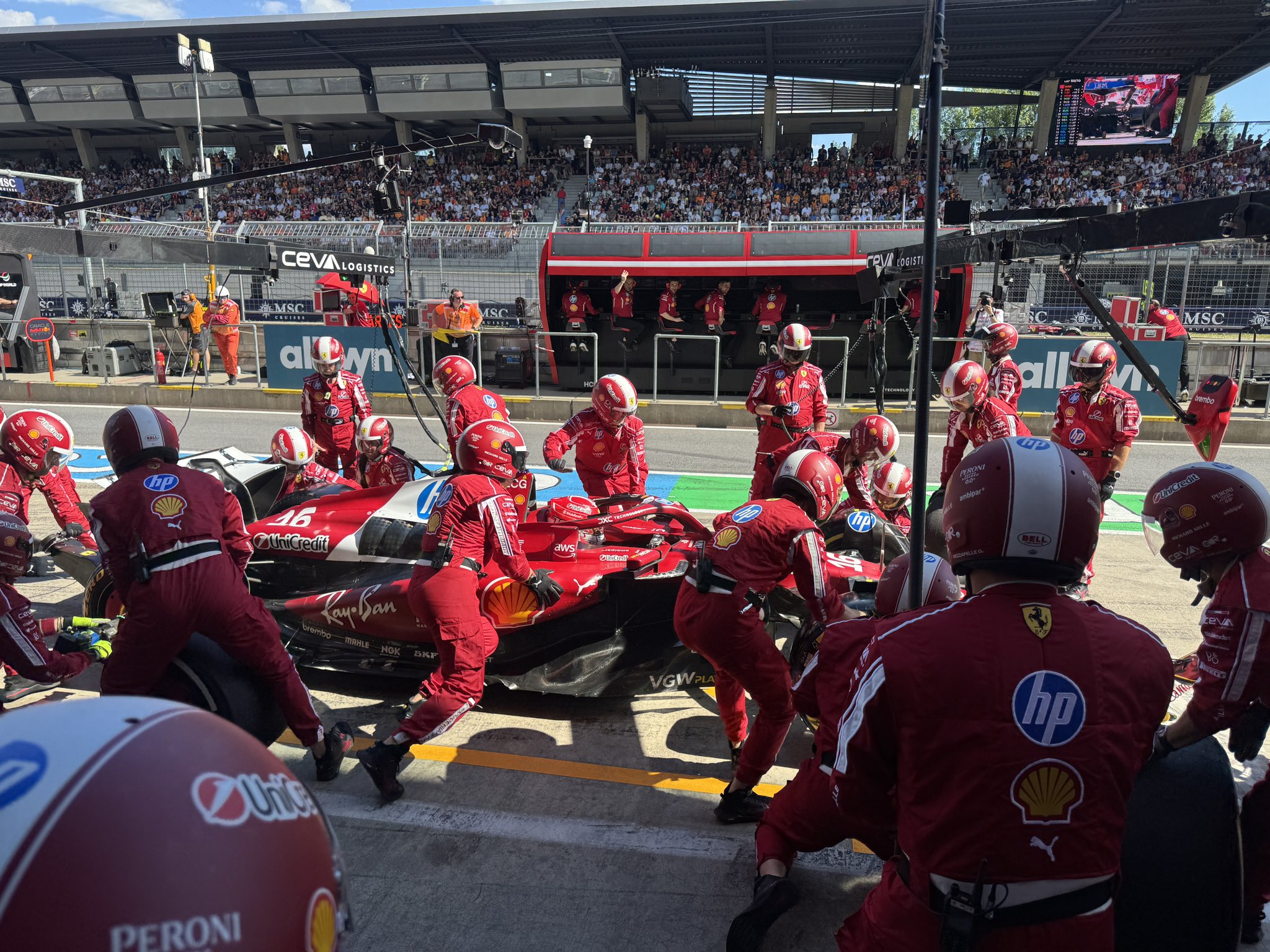
There are weekends when it is necessary to focus more on the positives than on the negatives. For Ferrari, the Austrian Grand Prix was one of those weekends, with third and fourth place representing a satisfying result, both in terms of outcome and race pace.
Of course, if the target is McLaren, there is still a lot of work to do and the path remains steep. However, at this stage, Ferrari must move forward step by step, starting by consistently beating Mercedes and Red Bull—two teams that have often managed to stay ahead of the Maranello cars throughout the season.
For Mercedes, it turned out to be one of the most difficult weekends of the year, while Red Bull’s challenges began already in qualifying due to the heat. It reached a point where even had Max Verstappen completed his final attempt, it would have been difficult for him to beat Charles Leclerc’s time. The fact that the Dutchman was later taken out of contention by Kimi Antonelli made things easier, though Ferrari already appeared to have the upper hand.
In a weekend focused on evaluating new upgrades and, most importantly, leaving the other top teams behind, Ferrari completed its mission. Charles Leclerc secured a strong podium, while Lewis Hamilton claimed fourth place in a relatively solitary race for both Ferrari drivers, given their significant advantage over Mercedes.

Jérôme d’Ambrosio, Ferrari’s deputy team principal who replaced Frédéric Vasseur—forced to leave Austria before the race for personal reasons—emphasised that the key factor was the clean execution across the entire weekend.
Speaking to Sky, Jérôme d’Ambrosio explained that they had managed to put the weekend together, which was very important both in qualifying and the race. While McLaren had a stronger pace and finished ahead, he stressed that Ferrari had to stay focused on itself and continue improving gradually.
He added that the developments brought to this round moved in the right direction. There was still a lot of work ahead, but, as Frédéric Vasseur had been saying since the beginning of the season, piecing the weekend together was essential because it allowed the team to work calmly and make progress.

At certain points, Ferrari even matched McLaren’s pace. However, as Jérôme d’Ambrosio pointed out, it was more important to understand why the McLaren team, under certain conditions, appeared to slow down, given that Ferrari had run a linear and consistent race.
A similar situation had also occurred in previous Grands Prix, such as in Spain, where McLaren only displayed its full potential after feeling pressure from Verstappen. At that point, the Woking team quickly pulled away from its rivals, including Ferrari, which until then had been keeping up a decent pace.
D’Ambrosio explained that Ferrari had executed a straightforward race, followed the ideal strategy, optimised pit stops, and maintained a linear approach. As for what other teams did to find more performance in certain moments, that was something only they knew. For Ferrari, it was more interesting to understand why McLaren decided to push harder or showed something extra at specific stages.
One of the main talking points during the race was lift and coast, meaning lifting off the throttle before braking in order to reduce thermal stress on the car. This has long been a known issue for Ferrari and is always a delicate matter in Austria, where the circuit is one of the most demanding in terms of power unit and brake management.
Racing at altitude and facing heavy braking zones makes cooling management a key focus. D’Ambrosio explained that brake management was part of a more or less normal optimisation strategy. It was never pleasant for the driver, but as soon as they operated closer to the limit than expected, they had to rely more heavily on this technique.
It was not a problem unique to Ferrari, especially on a track like the Red Bull Ring. However, given that they were running in a no-man’s land between McLaren ahead and George Russell far behind, Ferrari opted to be even more cautious. Jérôme D’Ambrosio noted that in that situation, with no immediate threat, it was logical to ensure the car stayed within safe limits. It was fairly normal and not unusual—data from GPS showed many other teams were doing the same.
Jérôme D’Ambrosio also spoke positively about the updates introduced over the weekend, particularly the new floor, which delivered the expected technical feedback. He noted that they had put it on the car on Friday, and what mattered most when bringing an upgrade was ensuring data matched between the track and the wind tunnel. This was confirmed in Austria, representing a step forward. However, as he acknowledged, there was still more work to be done to improve the car’s overall performance.