
Formula 1 arrives at Spa-Francorchamps, the longest circuit of the year, marked significant variations in altitude, important undulations, and high-speed corners. Despite the ongoing weather uncertainty (currently it is raining at the circuit), the setup choice requires a compromise between the mixed second sector and the long straights. Good traction is also crucial for a strong exit from the first corner and to defend against attacks after Eau Rouge, at the end of the long straight.
These compromises favor teams with excellent mechanical balance and significant aerodynamic efficiency. Those able to load the wings without sacrificing too much top speed should have an optimal setup. It appears to be the perfect circuit for the Red Bull RB19, which has consistently had the most rear wing load this year and one of the highest angle of attack profiles for the front wing, although it flattens significantly at higher speeds (similar to the Mercedes and McLaren).
The revived McLaren also has good chances in Belgium, with team principal Andrea Stella only concerned about the slow first corner and the mixed second sector. The new MCL-60 seems to be the second-strongest car on a single lap.
The Mercedes, with the W14B, has focused on finding a balance between slow and fast sections, which has resulted in a race pace that is getting closer to Red Bull’s as each race goes by. The pole in Hungary showed that their qualifying performance is also improving.

The Ferrari car is a major unknown, as it could struggle with the need to run high off the ground due to the undulations and curb passages. However, the SF-23 Evo has often defied expectations, performing well where not expected and poorly where it should have shown its full potential. The new sprint-race format may assist the weekend for the men in Red.
Show your support for Scuderia Ferrari with official merchandise collection! Click here to enter the F1 online Store and shop securely! And also get your F1 tickets for every race with VIP hospitality and unparalleled insider access. Click here for the best offers to support Charles and Carlos from the track!
Thanks to the timely images published by Spanish pitlane reporter Albert Fabrega, we can analyze the setups and updates of the various cars.

Rear wing comparison
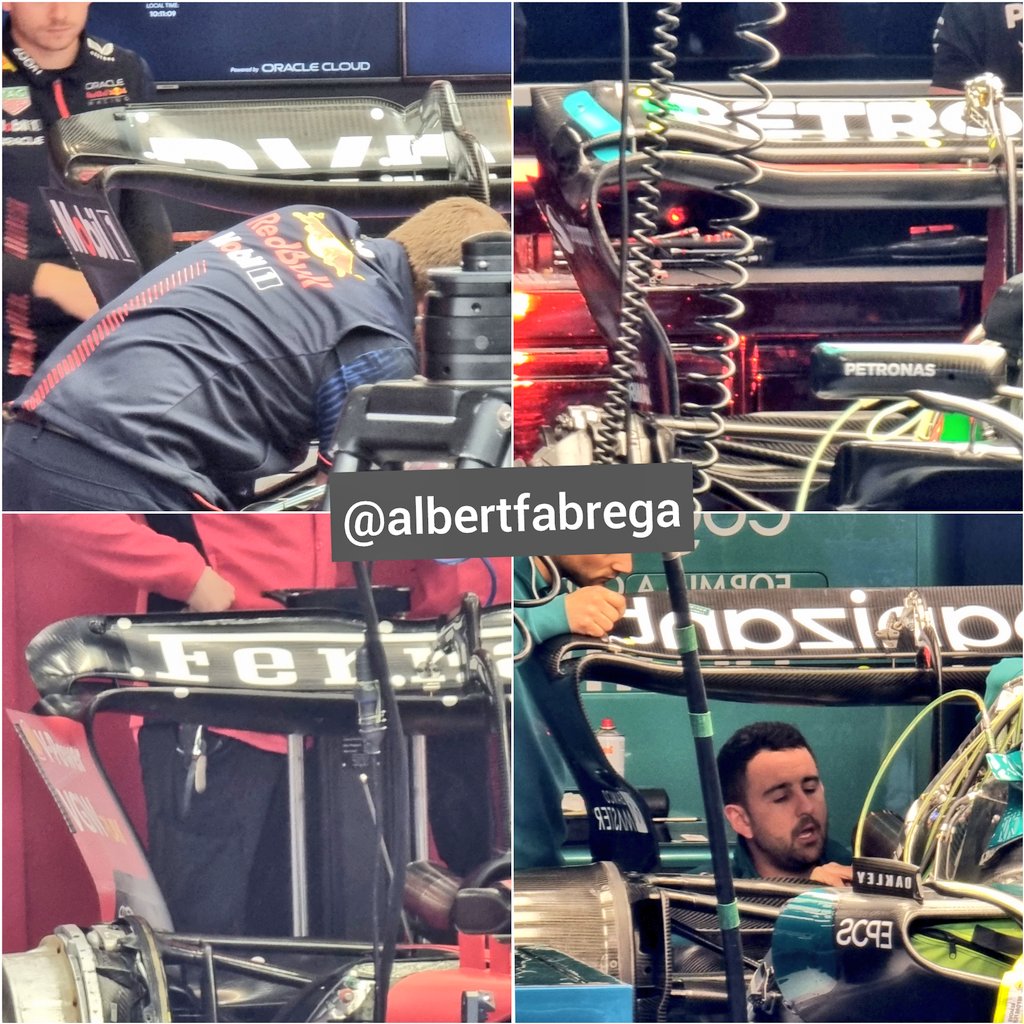
As hypothesized, among Ferrari, Mercedes, Aston Martin, and Red Bull, the latter is using the most loaded rear wing. Thanks to the excellent aerodynamic efficiency further refined with the latest update in Hungary, the RB-19 tackles the mixed sections with great stability and can attack using the DRS, which is also more effective than in less-loaded solutions. The choices in terms of wing load shown in the first image are quite similar for all the teams, aiming for a compromise. It is unlikely that we will see anyone trying very low-load solutions in Monza style this year. In all the wings, the primary load is provided by the upper profile.
Among other small details, we notice that only Red Bull and Ferrari have a V-cut on the upper profile just behind the DRS activator and will use a gurney flap (a small step on the exit edge) to give slightly higher load with DRS closed in view of the Belgian Grand Prix weekend.
Mercedes and Aston Martin will have a more modest DRS effect but generally less drag with DRS closed. In particular, for Mercedes, it is the least loaded solution they have brought to the track this year.
The McLaren has a highly loaded rear wing, with the new MCL60 demonstrating excellent aerodynamic efficiency.
On the other hand, Williams and AlphaTauri have very low wing load. Haas chose an anomalous solution, being the only one to use an upper profile with a low load, evidently for reduced drag even with DRS closed.


Leave a Reply