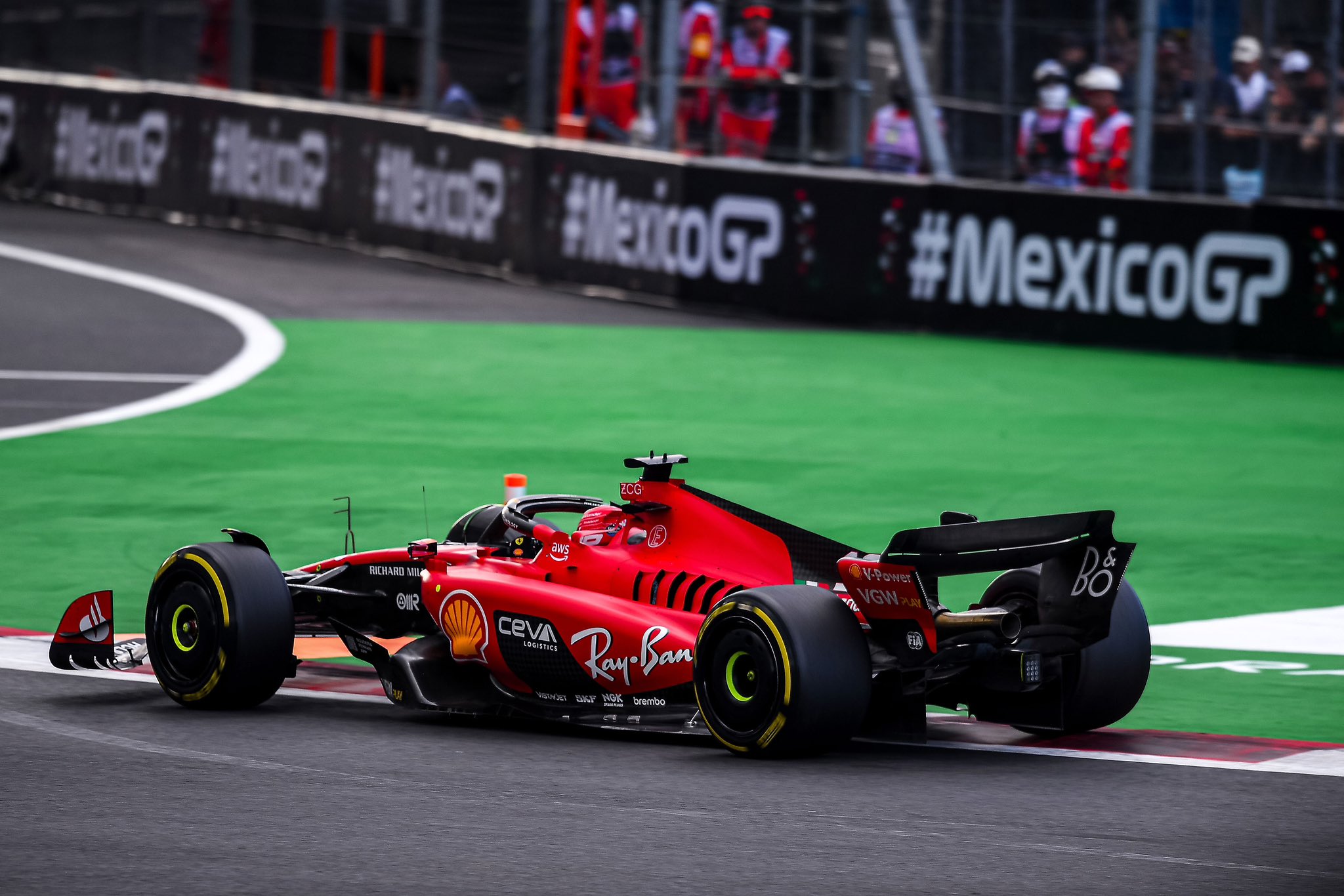
Scuderia Ferrari didn’t have the best start to this weekend, but it made a comeback. Let’s break it down. In the first practice session, the various drivers tested the Pirelli prototypes for 2024, which are expected to reduce graining, a phenomenon that occurs when different layers of the tire have different temperatures. The Prancing Horse, considering the issues faced by Sainz, had only one car available in FP1 to continue with the usual setup research. The Maranello team tried to make the high downforce setup work.
The high-load rear specification was combined with a high downforce beam wing to generate clean downforce from the floor. During the initial runs, first with the prototypes and then with the soft tires, we saw the SF-23 being unstable during the transition phase between entry and reaching the apex. At various points on the track, the two Italian cars tended to lose the rear when the car reached maximum lateral load.
Issues that are usually “reserved” for the RB19 but are now affecting the Modena cars on this track. The Ferrari drivers were, therefore, forced to correct their trajectories, which led to losing valuable fractions of a second. It’s somewhat strange that Ferrari suffered from oversteer on entry rather than the “usual” understeer, which usually occurs in the initial phase of the corner.

This behavior stems from a specific setup approach they adopted, fully aware that the front end would be weak and needed preservation. For FP2, they tried to correct the balance by moving it more towards the rear. From a mechanical perspective, the technicians in red managed to utilize the car’s characteristics fairly well, highlighting traction in the final part of the track, although it wasn’t perfect yet.
Mexican GP 2023/Performance Analysis: Ferrari Still Needs to Improve S3
The second session saw several adjustments to the stiffness of the front anti-roll bar, likely stiffening it to seek greater precision in the high-speed “snake.” However, it’s unclear if this measure reduced rear grip at low speeds in the slower corners of the track.


Source: FUnoanalisitecnica
Above, we see what was mentioned earlier: in Sector 1, Charles Leclerc can match Max’s times, while in the middle section, Norris and Perez join the fray, both equipped with a lot of downforce. In the final part of the track, where the red car should dominate due to high traction, this hasn’t been the case. The Emilian team needs to extract the most from their car because they struggled last year as well.
Show your support for Scuderia Ferrari with official merchandise collection! Click here to enter the F1 online Store and shop securely! And also get your F1 tickets for every race with VIP hospitality and unparalleled insider access. Click here for the best offers to support Charles and Carlos from the track!
Red Bull had another day of mixed fortunes, with Perez having more difficulty finding his rhythm. Max, on the other hand, quickly found a good feeling with his RB19, which utilizes good aerodynamic efficiency and enhances its capabilities between S1 and S2, in the medium-speed and wide-radius corners where it sails smoothly. In the fast twisty section, the McLaren was the only one at the level of the Austrian car.
The front of the MCL60 is very stable, and the car’s behavior on curbs at medium and high speeds provides excellent results. The RB19 still needs improvement in T3, where it failed to “copy” Ferrari’s and Mercedes’ lines that develop more mechanical grip at low speeds by attacking the curbs, something the Milton Keynes-based team still needs to work on.

Source: FUnoanalisitecnica
As shown in the micro-sectors chart, Ferrari constructs its lap in the straights, where it manages to gain an advantage over the RB19. This is a reversal of the trend compared to last year when the F1-75 performed better in the middle sector, and the RB18 had more top speed. In the final sector, the chart is broken, even though the SF-23 has even more untapped potential. The micro-sector data indicates better corner entry compared to Red Bull, meaning the setup changes post-FP1 have worked.

Source: FUnoanalisitecnica
The chart above summarizes maximum and minimum speeds for each driver. Scuderia Ferrari is the dominant force at low speeds, but it’s yet to translate this into a good performance in the third sector. Red Bull follows closely, but they struggle more over the curbs, requiring them to cover more ground and losing valuable fractions of a second in the slow section. For this reason, Max only ranked fifth.
Mercedes, on the other hand, faced difficulties overall, especially in the middle sector where they need load and a solid front end to have agility in directional changes. Hamilton decided to change direction from the first practice session, requesting a rather significant setup change. In this case, it seems they worked on the rear anti-roll bars, probably softening them. A lot of work was done overnight for the dry lap pace.

Source: FUnoanalisitecnica
Finally, we present a chart summarizing the forces at play. The times are all “ideal,” obtained by adding the best sectors from each driver in all the laps they carried out during the second free practice session. McLaren is the second-strongest force, just a tenth behind Max Verstappen. Charles Leclerc and Sergio Perez, however, are tied in this particular ranking with a time difference of about three-tenths of a second.
Mexican GP 2023: Performance Analysis, Race Pace Simulation: Ferrari Shows Good Pace Despite Graining
During the tests conducted in the latter part of the second free practice session in Mexico with a significant amount of fuel on board, most teams chose the medium tires, a compound on which Norris maintained the best pace, almost on par with Red Bull. During the very first laps of the long runs in FP1, Max had expressed great dissatisfaction with the handling as the rear tires degraded more than expected. This setup issue was subsequently corrected.

Source: FUnoanalisitecnica
Third place went to Charles Leclerc in the Ferrari, who seemed to have worked optimally with the medium tires. However, the presence of understeer somewhat limited the pace because the rear of the car was still too light. Furthermore, SF-23 #16 experienced a certain degree of graining, which contributed to decreased car responsiveness. Charles Leclerc managed to stay ahead of Hamilton by about one-tenth on average, even though Mercedes seems to have made a comeback overall during the long runs.
Source: Alessandro Arcari and Niccoló Arnerich for FUnoanalisitecnica


Leave a Reply