The safety team at the Red Bull Ring in Spielberg has provided details about how they evaluated and acted when Scuderia Ferrari Spanish driver Carlos Sainz stopped at the side in Austria, due to the fire caused by the failure of his F1-75 power unit. Carlos was in third place when he had to retire with 12 laps to go, parking up in the run-off area at turn four in Spielberg.
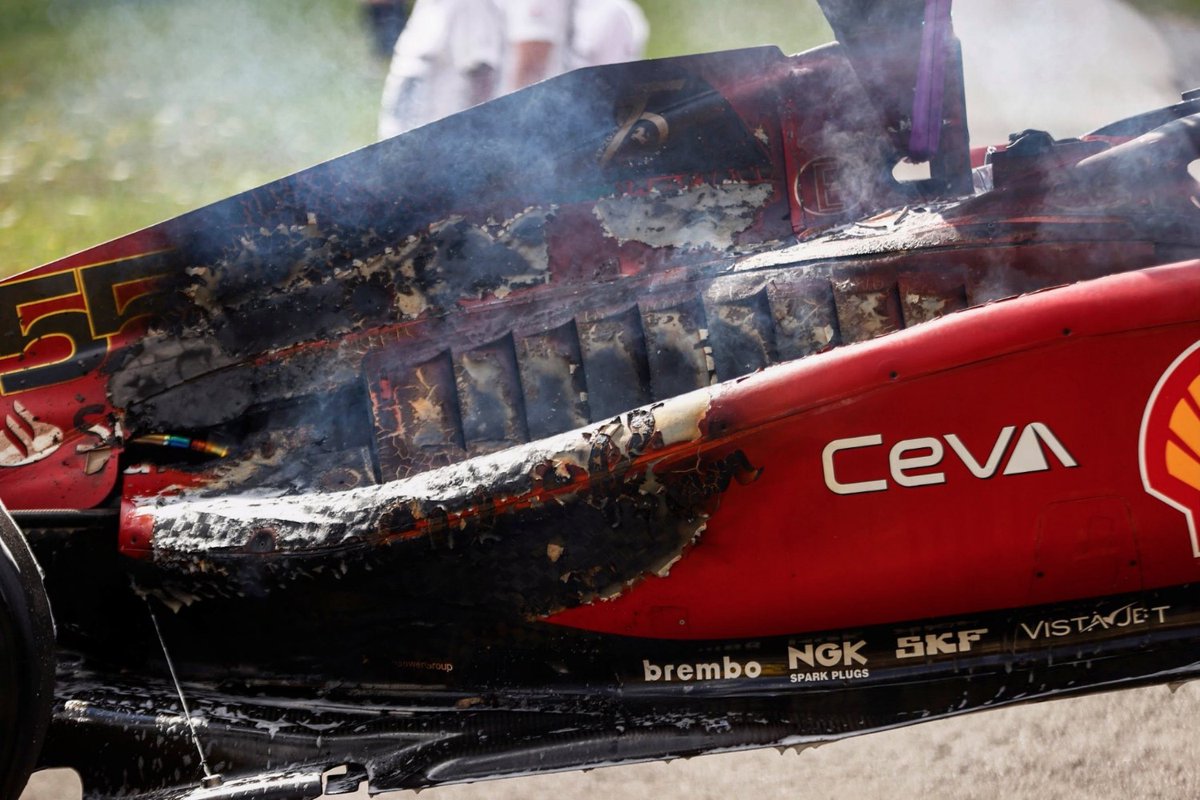
The F1-75 car became engulfed in flames and while the Ferrari driver tried to release himself from the cockpit, the Maranello team’s challenger started to roll down the hill with just one marshal arriving at the scene, as he attempted to stop the car with a stopping block, before running back for an extinguisher. Carlos Sainz himself was critical of how the situation was managed at the Red Bull Ring. In a recent statement released by the Spielberg track’s safety team, the marshals have been defended.
Ferrari junior Jules Bianchi tragically died following a crash with a recovery vehicle at the 2014 Japanese Grand Prix resulted in stringent safety measures introduced by the FIA, which meant that the marshals at the Red Bull Ring in Spielberg therefore having to wait before taking action.
The statement explains: “After the terrible accident of Jules Bianchi in 2014, the FIA’s rules regarding recoveries and interventions on the track have been drastically tightened. Intervention is only allowed after instructions from race control. On the one hand, this naturally increases the safety of the drivers and marshals, but on the other hand, it has the disadvantage that interventions take a little longer.”

Explaining how “several unfortunate circumstances” were responsible for the delay in tackling the blaze, and that just one fire extinguisher would not have been enough to put the fire out, the statement continued: “The place where Sainz parked the Ferrari was not visible from the marshals’ stand. They received instructions over the radio to go to the car with fire extinguishers, and when they saw the situation, they made the decision to call in the fire engine (S-car). This decision had to be made within seconds and, in retrospect, was absolutely correct. If you remember [Romain] Grosjean’s accident, in a situation like that, hand-held fire extinguishers are absolutely not enough. Therefore, the fire extinguisher was turned off and the car was [left], which led to that unfortunate image on TV of the marshal “running away”.
Carlos Sainz was hurried in getting out of the Ferrari F1-75 car as flames started to creep forward up the bodywork of the Maranello team’s challenger.
Show your support for Scuderia Ferrari with official merchandise collection from Puma! Enter the online Puma Store and shop securely! And get your F1 tickets for every race with VIP hospitality and unparalleled insider access. Click here for the best offers to support Charles and Carlos from the track!

The Spaniard immediately attempted to get out of the cockpit by himself, as the Ferrari car rolled back down the hill towards the circuit, a situation that marshals also pointed out was a mitigating circumstance.
“Another problem was that Sainz, understandably, became nervous in the vehicle and went off the brakes too early. The wedge had to be pushed under the rolling vehicle, which of course made the whole thing extremely difficult. However, due to the resistance of the wedge, the vehicle steered in and stopped at the guard rail. Afterwards, the fire could be extinguished with a few pushes of the extinguisher.” – the statement concluded.


Leave a Reply