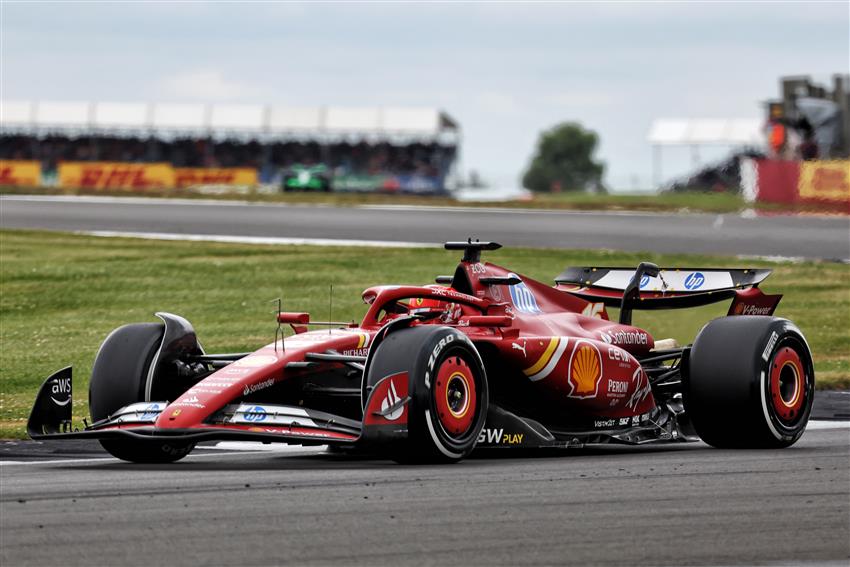
The first free practice session for the 2024 Formula 1 British Grand Prix was likely one of the key moments for the remainder of Ferrari’s season. The Maranello team, for once blessed by the weather, was able to complete an intensive comparative work program between the two cars. Charles Leclerc took to the track with the more updated version of the SF24, while Carlos Sainz ran with the aerodynamic configuration that preceded at the Barcelona package.
We have already explained why this moment is particularly delicate for the Maranello team, and clearly, the need to quickly find a solution to the emerging problems is such that some free practice sessions must be sacrificed to collect data from the track. Although the lap programs were not perfectly identical between the two drivers, it is possible, by making a careful comparison and weighing the collected data, to draw some conclusions even with only the data available to us, since some trends are sufficiently macroscopic to be noticed even without the details from load cells and various sensors on the cars.
Visually, the bouncing on Charles Leclerc’s car in the fast sections was notable
First of all, it must be stated that even from the simple onboard images, some differences were easily visible to the naked eye, foremost among them the aerodynamic bouncing, which was abundantly present on Charles Leclerc’s car and practically absent on Carlos Sainz’s. The impression is that in corners with a fairly constant radius, the phenomenon is present but less impactful, but in the entire central sector, the difference in car behavior is clear, with the rear end tending to become unstable in the middle of the curve, precisely where the bouncing becomes more pronounced. The impression, therefore, is that one of the reasons the Maranello engineers have not been able to predict the recurrence of the phenomenon or see it in wind tunnel simulations is that there is a strong dynamic component of the car that triggers it, while under stable conditions, the problem loses at least an order of magnitude. The bumps in Barcelona and the undulations in Austria evidently acted as catalysts for triggering the bouncing, while the very smooth asphalt at Silverstone helps the SF24 defend against the phenomenon, until the central sector is reached where the violence of Copse first, and immediately after the continuous load transfer of the Maggots-Becketts-Chapel sequence, puts the system in evident crisis. The data broadly confirms what has been observed so far. We took the readings of the best lap on hard tires from both Ferrari drivers and, as usual, compared them.

Looking at the telemetry data from FP1, the first premise is clearly that the two drivers completed the lap with significantly different Power Unit mappings, with Carlos Sainz able to push almost to the maximum level of the engine (evidently to collect data under extreme conditions). This is evident from the first braking at turn 3, and then throughout the exit of turn 5 onto the straight towards Brooklands and Luffield. In the latter turn, turn 7, it is noticeable that at medium-low speeds, in a long corner with a fairly constant lateral load, the updated version of Charles Leclerc’s SF24 produces a greater amount of aerodynamic load than Carlos Sainz’s Ferrari, confirming what Ferrari itself stated on the eve of the Spanish Grand Prix, that the new package brought an increase in load even at medium-low speeds.
However, from the exit of Luffield onwards, troubles begin for the Monegasque driver and for the updates on the Ferrari car. At Copse, the Monegasque driver passes through 5 kilometers per hour slower than his teammate and lifts his foot off the accelerator significantly more than Carlos Sainz, and then at the entrance of Maggots, the hardest stretch begins, with the Spaniard suffering from less load at Becketts but having much greater stability of the car, so much so that the passage at Chapel onto the Hangar Straight sees the Spaniard passing through 9 kilometers per hour faster than the Monegasque. In the next turn, Stowe, however, the load of the updated SF24 reappears, considering that the passage through the challenging turn 15 of the English track is a fairly clear indicator of the aerodynamic load levels of the cars. Once again, a smooth track and a corner with a soft, constant radius slow down the onset of aerodynamic bouncing and allow Charles Leclerc to pass 6 kilometers per hour faster, then entering the last stretch and the final low-speed chicane, where mechanics take precedence over aerodynamics, and once again Carlos Sainz finds greater performance.
The behavior at turns 16-17 (but also previously seen at turn 4) seems to indicate that the difficulties due to aerodynamic bouncing force a non-ideal mechanical setup in an attempt to make the phenomenon at least manageable, and therefore Carlos Sainz’s car appears to have smoother and more natural passages in particularly slow sections. It is clear that Ferrari has a problem to solve, and this session confirmed that work at Maranello is actively underway. We will see if the weather, threatening rain, will allow a clean second session, how Ferrari will take advantage of it to try to advance in their understanding of the package, and how the Maranello team will work to find a solution.