Scuderia Ferrari looked impressive in the first day of the pre-season testing session at the Circuit de Catalunya in Barcelona. The Maranello team was fastest for most of the morning session, with Charles Leclerc setting his best time early on a 16-lap run, which could indicate that he was not on a low-fuel glory run. At this early point of the first testing session, most teams complete their runs with roughly half a tank of fuel as it provides a better baseline to gain useful information that can be compared with the CFD and wind tunnel data which has guided the development of the car up this moment. But, of course, given the many variabls and unknown factors, comparisons of pure lap time are pretty much irrelevant.
Most importantly, Scuderia Ferrari completed a total of 153 laps on Wednesday: 80 with Charles Leclerc in the morning, the remaining part in the afternoon with Carlos Sainz. At the end of the day, the F1-75 cars finished in P2 and P3: 1’20 “165 for the Monegasque, 1’20’416 for the Spanish driver. Both with C3 tires. At the top of the timesheet, for the record, there was the McLaren of Lando Norris who set the best lap time of the day with the C4 tire, 1’19’568.
Italian website funoanalisitecnica.com tried to make an analysis based on what their correspondent observed on the track; on how the latest addition to the Maranello family has “defended itself” on the tough Catalan circuit, which has always been a cynical and ruthless test and why Formula 1 decides to use this circuit for the pre-season testing session.
Let’s go directly to the main zones of the track. The first straight to be analyzed is the one between Turns 7 and 8, which is basically a quick change of direction left-right that usually made it difficult for older generation cars which were not perfectly balanced.

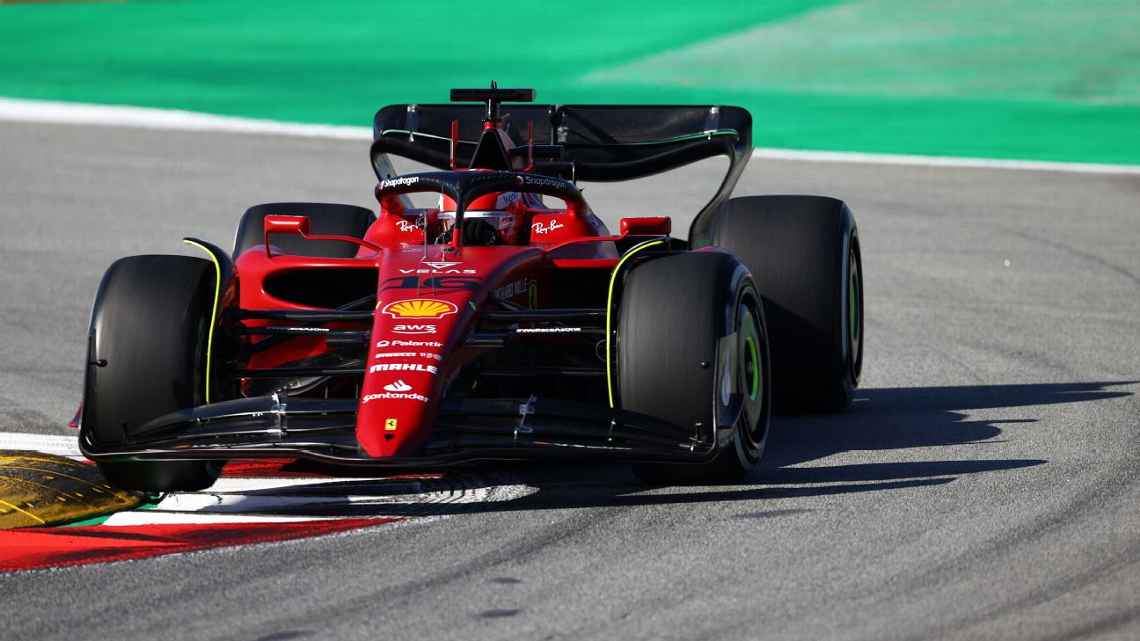
Observing the Ferrari F1-75 for a few laps in this specific section, during its long run, it was possible to notice a very precise car on the front and under braking. In addition to the ease of entering the corners, it seemed that the chassis was able to generate an excellent downforce which allowed the two drivers of the Scuderia to bring a lot of speed to this portion of the track.
Carlos Sainz, compared to Charles Leclerc, tended to enter the two folds with a slightly higher speed and then slide the car. A characteristic peculiar to his style and that he used with old school cars. The same thing happens with the new single-seaters.
Trying to make a first general evaluation, one could not notice a too different handling in these “next gen” cars as compared to the last season. Furthermore, it is interesting to see how the red car, by “listening” to the new engine, shows a good acceleration in output supported by an efficient hybrid system.

Another crucial sector, perhaps the one that at times was a big problem for Ferrari, is the third one. The slowest section of the track where, usually, the tires suffer. It is an area, the one between Turn 10 and Turn 16, in which aerodynamics matters less given the relatively low speeds.
Show your support for Scuderia Ferrari with official merchandise collection from Puma!
It is the mechanical balance that has the greatest importance in this part of the track. As well as the ability to effectively unload the power of the Prancing Horse’s turbo-hybrid V6. Well, even in the dreaded T3, the results are apparently positive. funoanalisitecnica.com emphasize why the elements for making a complete assessment are still few and superficial.
In any case, the F1-75 showed overall good behavior in an area of the Spanish track where even the Mercedes W13, especially with George Russell in the morning, gave good visual indications. Hamilton, in the afternoon session, showed a pointed motion front and a slightly swinging rear end. A characteristic that is often observed in the driving style of the seven-time world champion.
The real positive aspect after the first session of the long-awaited winter tests is that of reliability. There was no problem whatsoever and the 153 laps carried out certify it and put the Red team at the top of the special ranking of marathon runners. All scheduled stints were performed according to what was planned.
There was not the slightest hint of any issue or asset problems. Clearly some different set-up configurations were tried in order to understand how the car reacted to mechanical and aerodynamic changes. Even in this situation, everything went smoothly and without slowing down the programme.
With confidence, therefore, Ferrari is preparing to face the second day of testing which will start, as usual at 9:00 am. But the work in the motorhomes of the Maranello team does not stop. It is time for data analysis. It will be a long night.


Leave a Reply