Let’s analyze Leclerc’s strategy at Imola: could the soft tyres have been fitted to try and fight for the podium?
In this analysis, we go over Charles Leclerc’s Imola GP from a strategic perspective, evaluating whether Ferrari could have made different choices to aim for the podium, or if, on the contrary, they maximized the potential.
Start: great move by Ferrari but unlucky outcome
Ferrari was undoubtedly the team that best interpreted the first phase of the race from a strategic standpoint. On lap 11, they made an aggressive call by pitting Leclerc, who was stuck in P9 behind a DRS train of hard-to-pass cars. In clean air, the Monegasque was finally able to fully express the excellent race pace of his SF-25, pulling off a huge undercut that saw him virtually gain 5 positions in a single lap.
The undercut was so powerful that it caught many rivals off guard, leading them to change their plans and follow Ferrari’s lead. This had a double effect: on one hand, it confirmed the effectiveness of Maranello’s move; on the other, it made the strategy less risky, as most competitors pitted soon after, cancelling the chance to build a significant tyre advantage in the second stint.

However, the Virtual Safety Car on lap 29, caused by a reliability issue on Ocon’s Haas, wiped out much of the benefit gained from that brilliant strategic call. The drivers who had instead extended their first stint were able to pit while losing significantly less time. Ferrari correctly called Leclerc in as well, since staying out on tyres with 19 laps compared to rivals who had just pitted would have severely hurt his pace and ability to defend. However, by doing so, the Monegasque dropped from a virtual P4 to P10, paying a heavy price for the VSC arriving at the worst possible moment for his race.
Second SC: the decisive moment
Having climbed back to P6 and about to overtake Lewis Hamilton to chase down Alex Albon in P4, Charles Leclerc’s race was shaken again on lap 46 by the arrival of the Safety Car due to a technical issue on Antonelli’s car. With only 17 laps remaining, having the right tyre set was crucial for the final result, especially with all gaps wiped out by the SC.
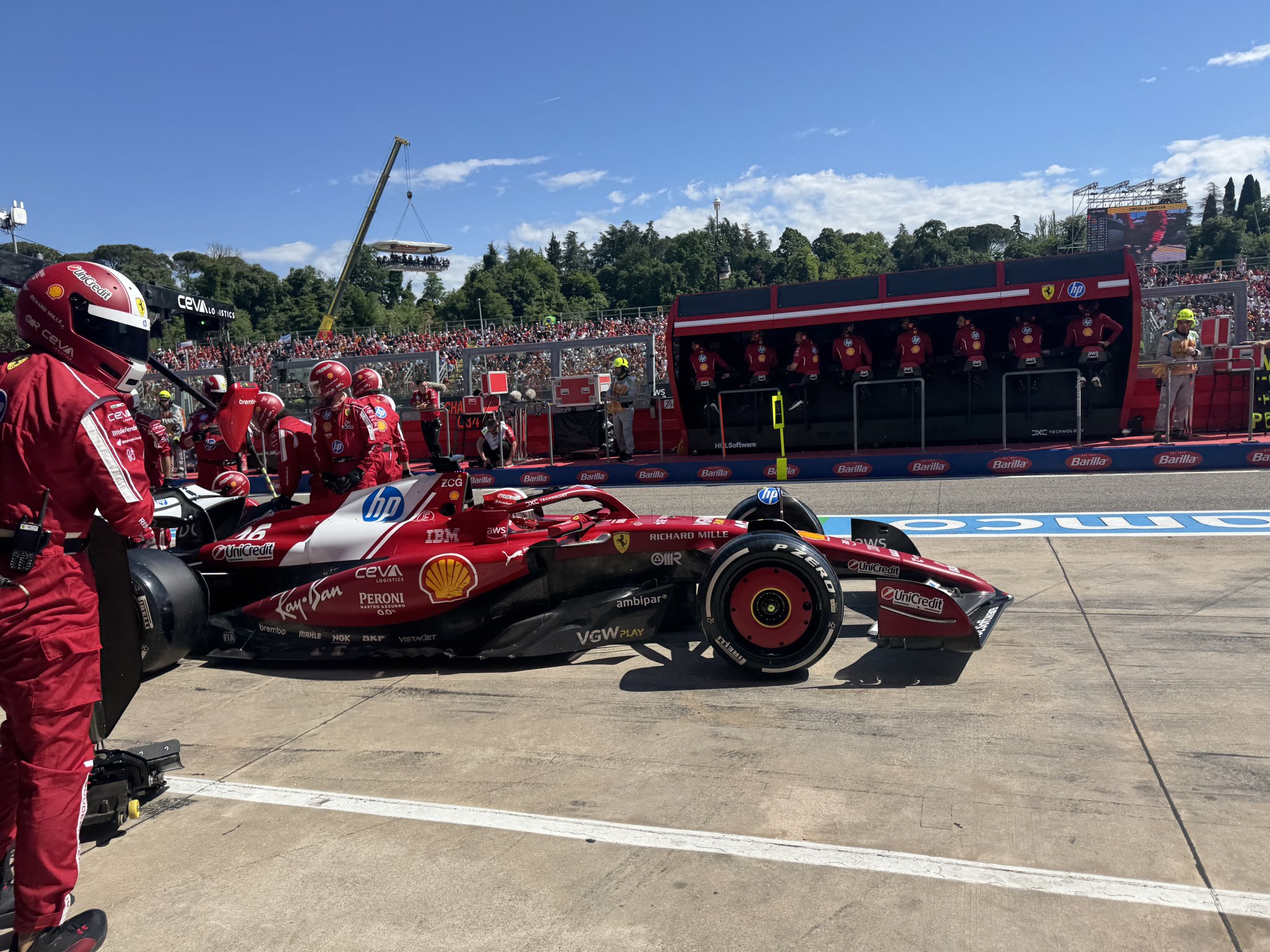
Charles Leclerc was well aware of this and asked to change tyres, having already complained about them earlier. However, the team was forced to tell him that there were no fresh sets left to fit, since he had already made two stops unlike most rivals. The only option would be to fit the softs – the fastest compound, but extremely fragile over race distance. Ferrari, though not entirely convinced, was open to following the driver’s wish after a rather heated radio exchange. However, Leclerc ultimately chose not to pit, having noticed that his teammate, just ahead of him, was already heading into the pit lane. He judged that the gap between them was too small to execute a double-stack stop without risking even more lost positions. Charles Leclerc therefore moved up to P4 on used tyres, eventually finishing the race in sixth place.

Could the softs have been fitted for a podium?
The gap between Lewis Hamilton and Charles Leclerc just before the pit lane entry was about 2 seconds. Therefore, Charles Leclerc’s judgment was extremely clear-headed and accurate: had he followed his teammate into the pits, he would have had to wait in the pit box, losing 2–3 more positions.
Additionally, as for the soft compound, it had already shown itself to be extremely fragile the day before, even over a single qualifying lap. In fact, the new Pirelli tyre, debuting at the Imola weekend, offered very high grip levels, which many teams struggled to manage throughout an entire lap due to overheating. So, the idea of completing a 17-lap race stint on them would have been very complicated.
The SC lasting longer than expected would have reduced that to around 10 laps, potentially making the option viable again, but that couldn’t have been known at the time of the call. On top of that, the restart would have involved dirty air and numerous battles, further increasing the tyre overheating. Therefore, fitting the soft compound would have been a very high-risk move and likely would not have enabled a fight for the podium, which would have required a much more durable compound.
In conclusion, Ferrari made all the right calls, maximizing Charles Leclerc’s race – a brilliant recovery from P11 that was unfortunately hampered by the VSC and SC arriving at unlucky moments, as the driver himself admitted over the radio.


Leave a Reply