The Austrian Grand Prix unfolded as expected, with no major surprises. The weather had tried to add some concern before the race at the Red Bull Ring circuit, with a few raindrops falling around 2:00 PM, but then the clouds chose to release rain elsewhere, leaving the track dry for all 71 laps scheduled for Sunday’s event in Spielberg.
Pirelli had predicted two stops with a heavy use of the Medium and Hard compounds, while there were also those who believed that there could have been three stops if tire degradation had been significant and the weather had been hotter, especially due to the relatively green track caused by Saturday’s rain.
The asphalt temperature of about 32°C helped the drivers manage their tires, allowing 14 out of the 19 drivers who completed the race to reach the checkered flag with only two stops. Verstappen, Tsunoda, and Magnussen could have also joined this group. Max opted for three stops to secure the fastest lap of the race on Soft tires in the final moments (1’07”012), Tsunoda had to return to the pits immediately due to a contact on the first lap, while Kevin Magnussen decided to take advantage of the Virtual Safety Car caused by Tsunoda and subsequently the retirement of his teammate Nico Hulkenberg, enabling him to switch to the Hard and Medium compounds and attempt to go the distance using only the Hard C3 tires.
Taking these considerations into account, only two drivers actually opted for a triple pit stop strategy: Lance Stroll, M-H-H-M, who finished in tenth place, and Oscar Piastri, who also used the same strategy and finished 17th, far behind his teammate Lando Norris, who came in 5th right behind the Red Bulls and Ferrari cars, eventually being promoted to fourth after the ten-second penalty received by Carlos Sainz after the race.

Max does as he pleases
Obviously, there’s nothing to say about Verstappen’s race. The Dutchman is completely in control of his car. He temporarily loses the lead of the race between the 25th and 35th laps, only because, unlike the Ferrari cars, he doesn’t take advantage of the Virtual Safety Car to make his first pit stop. However, his pace is much superior to his competitors, and despite this setback, he manages to win with one more stop than Charles Leclerc, finishing with a 5-second gap ahead of his opponent.
Max demonstrated great strength this weekend, and deciding to make the final stop on the last lap only confirms his superiority. It was also a smart move. If you can gain a point, why give it away to your rival? One should always try to obtain as many points as possible. If the drivers, or even sportspeople in general, didn’t think this way, what kind of competition would we witness?
Show your support for Scuderia Ferrari with official merchandise collection! Click here to enter the F1 online Store and shop securely! And also get your F1 tickets for every race with VIP hospitality and unparalleled insider access. Click here for the best offers to support Charles and Carlos from the track!

Ferrari, it’s too early to smile
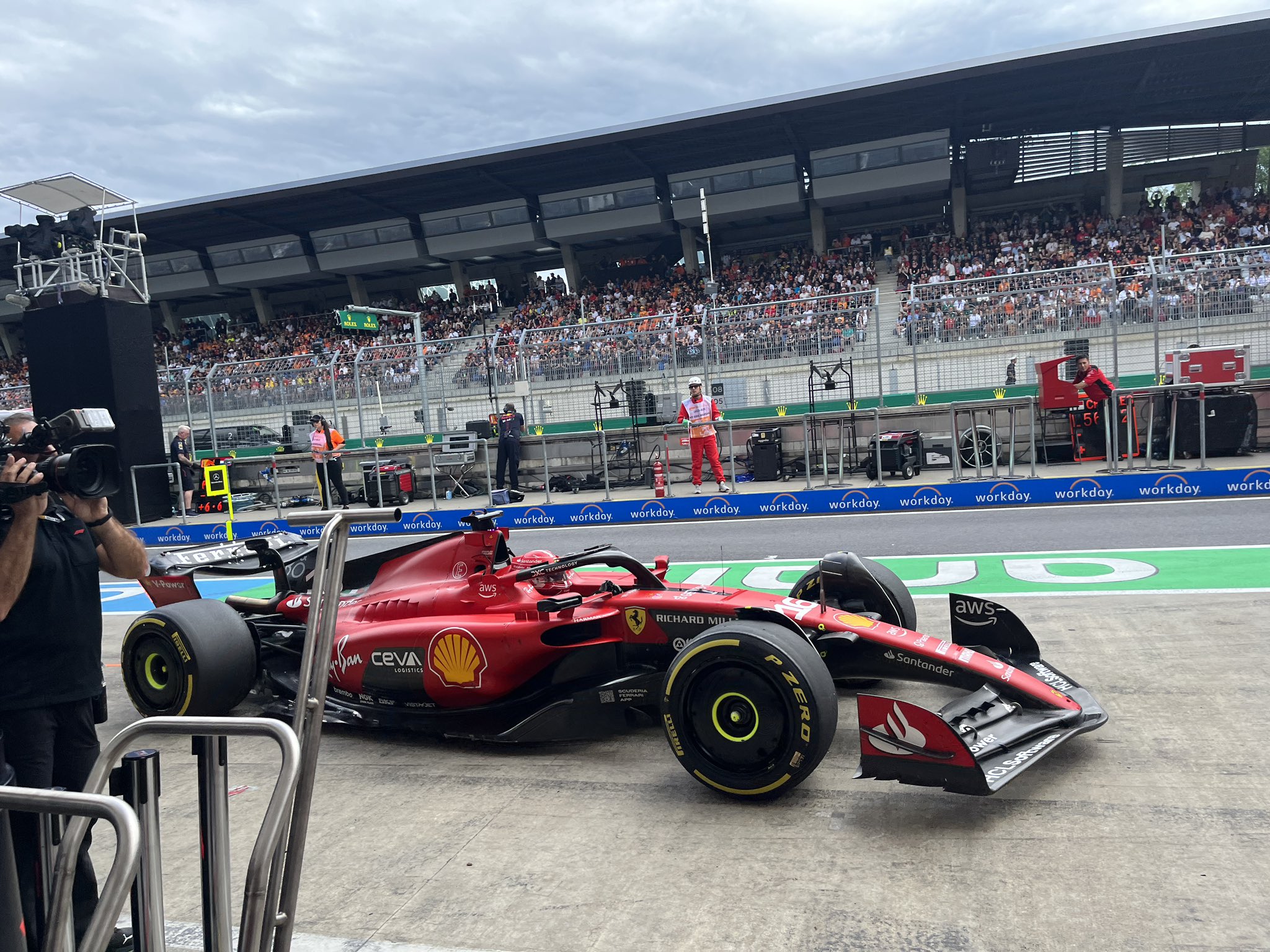
A good performance. Charles Leclerc showed a pace at times on par with Red Bull, responding to Sergio Perez and not allowing him to get close in the end. Obviously, Max is still far ahead, and we shouldn’t forget the issues Charles had yesterday. The fact that Carlos Sainz maintained a good level of competitiveness in all conditions, just like Red Bull, suggests that Ferrari may have made a mistake in setting up the car for the cooler conditions on Saturday. It’s a hypothesis that should be taken into consideration. What we still don’t like is that Ferrari rarely has a smooth weekend with both drivers.
The race is the most important event of the whole weekend, and on Sunday the Prancing Horse brings home a lot of points with a second-place finish (the 800th historical podium for Ferrari) and a fourth-place finish. However, besides being concerned about the issues Charles Leclerc had on Saturday, there’s another factor that worries us a bit for the upcoming events. Demonstrating good pace in Canada and being faster than the Mercedes-powered cars in Spielberg is not enough.
The Mercedes power unit (black this year) has always had disadvantages whenever racing at high altitudes. It hasn’t been talked about much this year, perhaps because Lewis Hamilton and George Russell aren’t heavily involved in the battle at the front, but before stating that Ferrari can aspire to become the second force in the championship, we would wait. Not for a long time, at least until Silverstone (next weekend). It’s a proper track where you need to have a good overall package, and Mercedes has always been among the frontrunners in past years’ events.
This doesn’t mean that progress hasn’t been made, on the contrary. Ferrari has made progress, and it’s evident. However, McLaren hasn’t been idle either and will continue to bring significant developments to Great Britain and Hungary before the summer break. Mercedes and Aston Martin will return to fight at the front on British soil. The conditions are set for a great challenge between the mentioned teams. It will be a big test for Ferrari, and then we’ll go to Budapest, a track that could once again be favorable for them.
Could Carlos Sainz have achieved more?
Carlos seemed a bit bitter at the end of the race. Certainly, the problem during the double pit stop cost him time, as did the 5-second penalty for repeatedly violating track limits and most importantly the additional ten-second penalty after the event. The Spanish driver mainly laments not having had the opportunity to overtake Charles Leclerc when he could and go on the attack against Max Verstappen; he believed he had the pace to stay with him. However, as long as he was behind the Monegasque, he had a good rhythm, but once he distanced himself from his teammate, he couldn’t maintain the same level seen at the beginning of the Austrian Grand Prix.
He put on a great performance, resisting Sergio Perez’s attacks for several laps and thus helping Charles secure second place. He played for the team, and perhaps without the Maranello team’s mistake, and his own, we could have seen two Ferraris on the podium. However, history is not made with “ifs” and “buts.” He had an impeccable race on Saturday, but on Sunday something was missing. Overall, if we look at the entire weekend, it was a better performance from Carlos. He can be satisfied with the work done, but obviously, he would have preferred to beat Charles. A healthy sense of competition wouldn’t hurt inside the Red box. As long as it’s healthy.
Mario Isola’s Recap
We conclude our analysis with the comment made by Mario Isola, the motorsport director of Pirelli, after the race: “Although the Grand Prix saw one driver dominate the scene from start to finish, there were also exciting moments in the battle among the other nineteen drivers. From our point of view, the balance is positive. The simulations before the race proved to be accurate on the track, in all the conditions we had throughout the weekend. We knew that the Soft compound wouldn’t be suitable for the race, but the Medium and Hard compounds allowed the drivers to push and attack when necessary.”
“The levels of tire degradation showed sufficient differentiation among them, and there was no excessive overheating. Even in terms of strategies, the predictions were accurate. The Virtual Safety Car intervention on lap 15 didn’t influence the number of pit stops but simply opened an alternative option in terms of the pit stop window. The top four finishers chose to complete two stints with the Medium compound and one with the Hard compound. I don’t consider Verstappen’s final pit stop relevant for this analysis. On the other hand, those who had chosen to keep two sets of C3 since Friday today chose to use both, combining them with a set of Medium tires,” concluded the Italian manager.


Leave a Reply