
In the Singapore night qualifying session, it was George Russell who emerged as the fastest driver. The Mercedes W16 improved significantly with the track evolution over the session, and Russell delivered perfect laps in Q3. Several factors contributed to Mercedes’ peak competitiveness, including the stop-and-go nature of the Asian circuit, which places minimal lateral load demands at medium and high speeds. Brackley’s car has consistently performed well on tracks with these characteristics, especially with high-downforce setups.
Max Verstappen joins George Russell on the front row for the third consecutive race, but an error in the chicane at turns 16-17 cost him a strong chance at pole position. A half-tenth improvement in the last three corners would have been enough to beat George Russell’s best lap. Saturday’s biggest disappointment was undoubtedly McLaren. It feels like a lifetime ago since their dominance in Hungary and Zandvoort. After two challenging races in Italy and Azerbaijan, this track seemed more suited to the strengths of the MCL39. Oscar Piastri (third) and Lando Norris (fifth) were never among the fastest in any phase of qualifying, but they minimized the damage by qualifying ahead of the Ferrari duo, who struggled with a car that is difficult to extract maximum performance from on a single lap.
Mercedes and Russell in pole for the second time this season
Russell’s first and second laps were the fastest of the weekend and improved the W15’s 2024 times by half a second—one-tenth more than Red Bull and four-tenths more than Ferrari. Russell gained most of his advantage in the first sector, exploiting a perfect entry into turn 1, similar to what Antonelli achieved. The excellent tire warm-up likely made the difference compared to the competition.
Another key factor was the outstanding efficiency of the W16. The car is extremely fast on straights while remaining competitive in the more technical sections of the track. On the straights, Mercedes gained one-tenth over Ferrari, which opted for a lower-downforce wing, and a few hundredths over the other top teams. The new front wing introduced in Singapore, featuring reprofiled flaps, also seems to have contributed to achieving an optimal balance for this circuit. The advantage built in the first half of the lap was enough to make Russell’s minor struggles in the second half, particularly through the tight turn 13, largely irrelevant for the final result.

Mercedes in strong position for the race
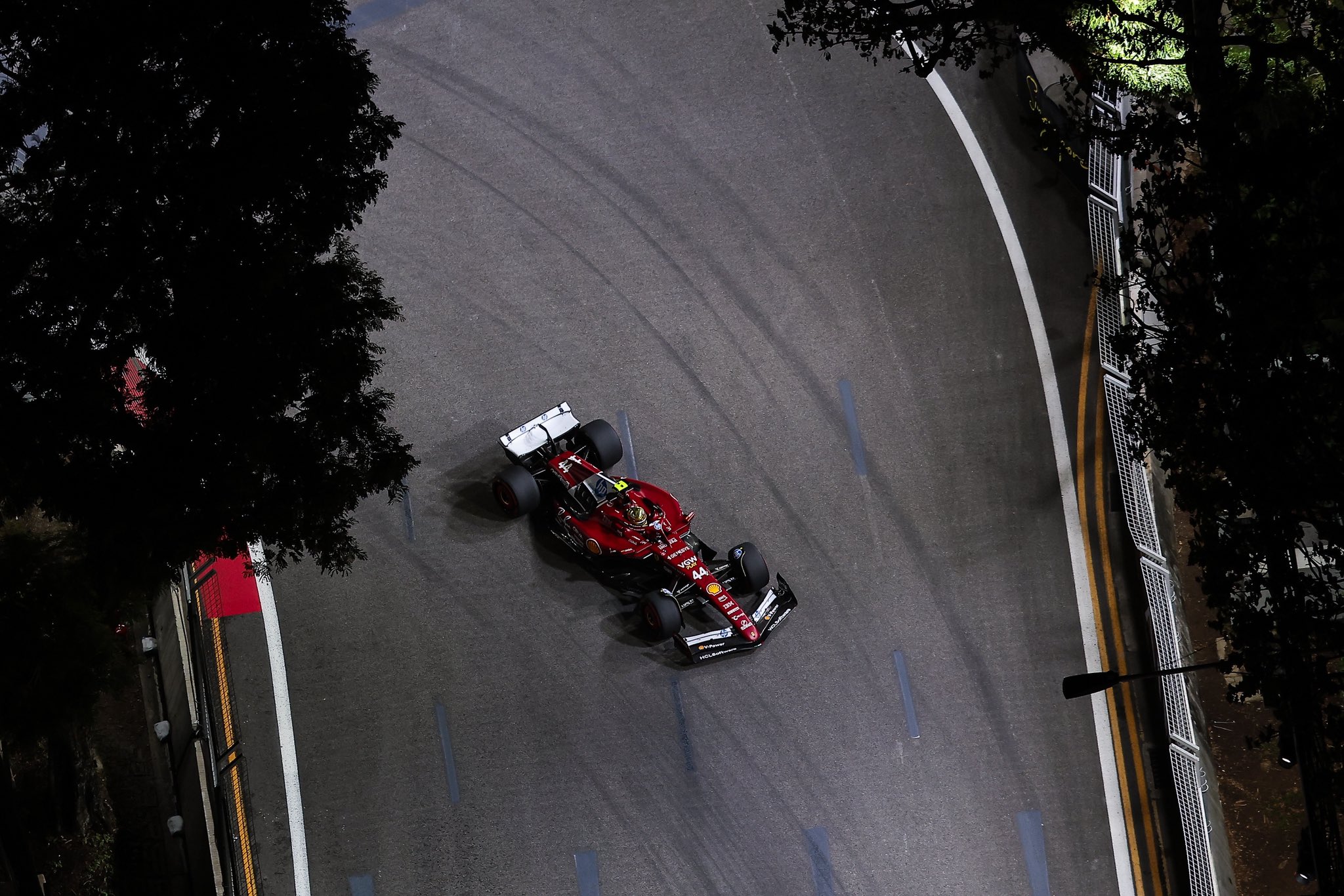
Today’s results put Mercedes in a very strong position for tomorrow’s race. After his Montreal victory, Russell can chase his second win of the season. Maintaining these positions would earn the team an additional 23 points over Ferrari, extending their lead in the Constructors’ Championship, which had seemed controlled by Maranello before Baku. The back-to-back Baku-Singapore races were seen as a major opportunity for solid points finishes, but they have proven challenging for both team and drivers. Lewis Hamilton and Charles Leclerc failed to extract the maximum from the SF-25 as they had in yesterday’s second practice, highlighting the fundamental flaw in Project 677, as explained by F1 expert Andrea Vergani for autoracer.it.
“FP1 went well; we were reasonably fast because we weren’t at the limit, in fact, we had a bit of margin. After that, we had to make changes to the car, and from FP2 onward we struggled a lot,” admitted a disappointed Charles Leclerc. Between Q1 and Q3, Ferrari improved by just half a tenth, while Mercedes, Red Bull, and McLaren improved by more than seven-tenths. The car’s usual issues continued to negatively impact performance, forcing engineers to raise the ride height. Ferrari is facing a nightmare that is expected to last another six races.
Mercedes takes over McLaren’s role, where is the dominant MCL39?
The pole battle between George Russell and Max Verstappen was decided by the Dutch driver’s mistake on his final lap. In that scenario, Lando Norris’ positioning in the chicane at turns 16-17 did not sit well with Helmut Marko, who said it was incomprehensible, as Norris had blocked Max in the final two corners despite having nothing to gain. Verstappen also commented that the incident could have been avoided given only 10 cars were on track in Q3.

Despite this, the reigning world champion still managed to beat both McLarens and will have the chance to attack Russell from the inside at turn 1. For the third weekend in a row, the Milton Keynes car has outperformed the Papaya, keeping the world championship dream alive. McLaren suffered particularly in the turn 1-2-3 and turn 8-9 sections, with no standout moments for either Piastri or Norris throughout the day.
If Monza and Baku had been labeled as outliers in McLaren’s season, Singapore qualifying raises a dangerous alarm in Woking during a critical period. The MCL39 was nearly half a second slower than Mercedes and Red Bull on a unique track, very different from the previous two circuits. In many past weekends, team and driver execution hid the car’s true pace, but today neither Papaya was competitive, meaning they could lose additional points to Max Verstappen over 61 laps. The last upgrades to the MCL39 arrived in Silverstone, after which Red Bull introduced two different packages, including adjustments to the RB21 floor to resolve simulation-to-track correlation issues. Did Andrea Stella’s team cut off development too early? The United States GP in Austin will provide key answers.


Leave a Reply