Scuderia Ferrari has achieved the best average feedback in the race pace simulation ahead of Sunday’s Emilia Romagna Grand Prix at the Imola circuit. Charles Leclerc started his high fuel run with the fastest times among the drivers on track in the second free practice session in Italy. However, the two Ferrari drivers suffered some degradation towards the end of the stint. Lando Norris also had an excellent simulation in terms of consistency and length. The Miami Grand Prix winner completed more laps than his rivals, sacrificing tests on the quick lap for qualifying. Both papaya-colored cars were balanced from the onboard perspective and experienced degradation later than the Ferrari cars of Carlos Sainz and Charles Leclerc.
Furthermore, McLaren is the only team to have tested both compounds. Oscar Piastri, on Pirelli white-banded tires, achieved a better average pace than his teammate, consistently lowering his benchmarks. Red Bull was slowed down by an imprecise front-end even in the race pace simulation. Similar to fast laps, Max Verstappen had an unpredictable car and struggled to bring temperature to the front tires. As Max’s average time shows, unlike McLaren and Ferrari, Red Bull’s pace wasn’t consistent.
Many laps were discarded from the simulation time due to long runs or errors, but despite changes in stiffness or wing adjustments, the RB20 never managed to find the ideal balance. On the other hand, Mercedes seems to have hit the right operational window at the Imola circuit. Lewis Hamilton, on medium tires, maintained a pace similar to Charles Leclerc and Lando Norris, also benefiting from a better driving style towards the end of the stint compared to the Monegasque. We’ll have to wait until Sunday for confirmation, meanwhile, we delve into the analysis with further considerations on the cars based on data collected from the second practice session.
F1, Imola GP Degradation Analysis: Ferrari suffers overheating towards the end of the stint.

By looking at the degradation chart we can notice how Lando Norris not only completed the longest stint but also experienced less degradation compared to his rivals. The British driver only increased his times in the last two laps, maintaining a good pace in the first 13 laps. Lando Norris kept his lap times within a range of 1.20.3 to 1.21.0 in the initial part of the simulation. Even better was Oscar Piastri’s performance degradation on hard tires. The Australian started his high fuel run on similar times to his teammate, lowering his benchmarks in the final part of the run.
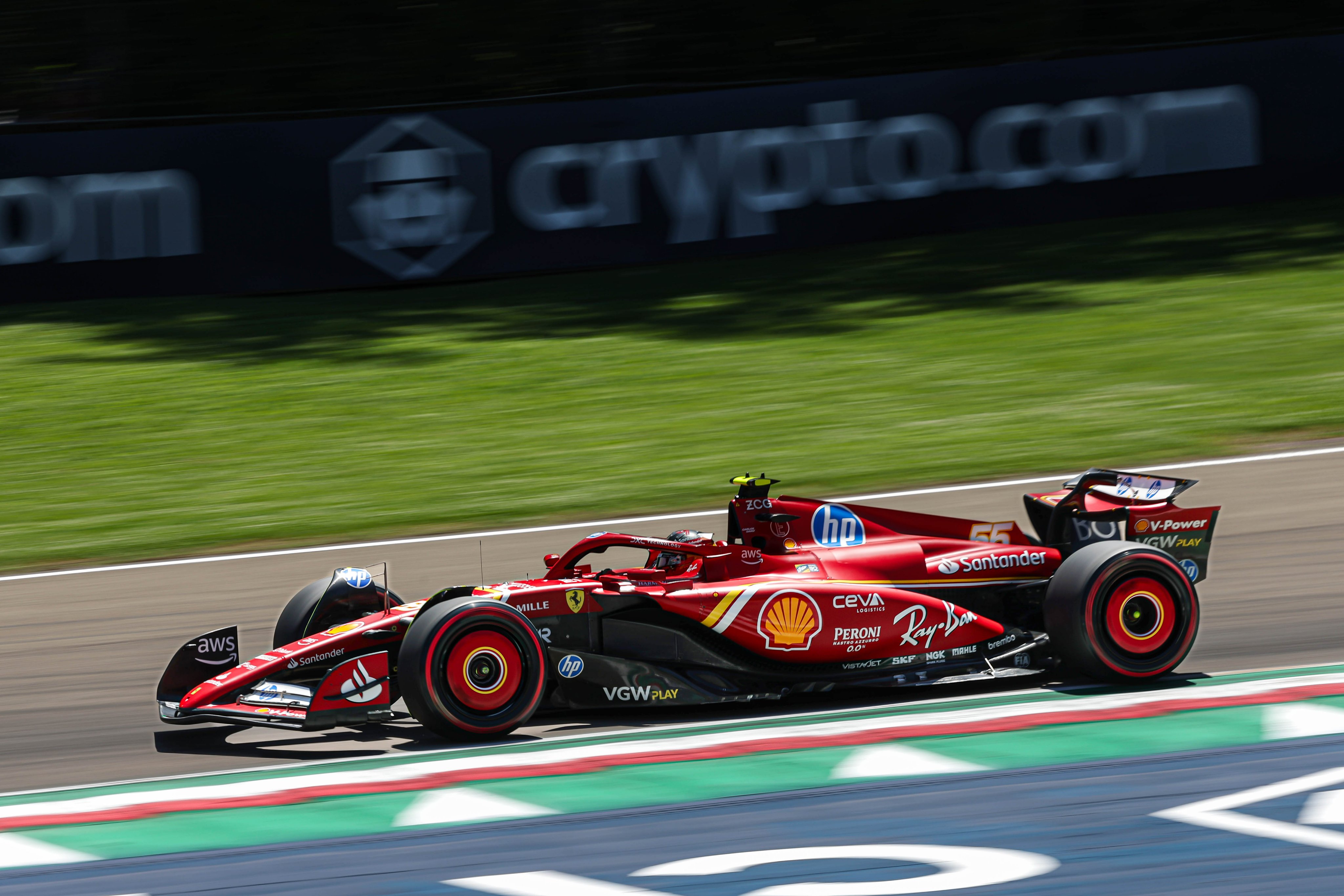
The two Ferrari drivers seem to have suffered more in the final laps of the simulation. Through onboard footage, the red car struggled with lack of grip on the medium tires. Clean driving at the beginning of the stint was replaced by some traction issues in medium-slow corners like Tosa and Variante Alta. The reason could be related to overheating rear tires, forcing engineers to study a solution to avoid the circumstance. The Maranello technicians have to quickly find a solution for this factor which could significantly slow down the pace of the red car and favor competitors throughout the stint.
Show your support for Scuderia Ferrari with official merchandise collection! Click here to enter the F1 online Store and shop securely! And also get your F1 tickets for every race with VIP hospitality and unparalleled insider access. Click here for the best offers to support Charles and Carlos from the track!

Regarding Red Bull, the telemetry data indicates a lack of pace compared to the top teams. It is observed that Checo Perez, probably due to traffic, increased his average pace from the third to the fourth lap. Max Verstappen was inconsistent with his times. The increased load on the rear wing, shifting the center of pressure of the reigning Formula 1 world champion car to the rear, may have weighed more on the front of the car. The aerodynamic balance shifted to the rear could therefore be the major cause of corner entry problems.
Ferrari therefore had a great first day of free practice. Two sessions where they debuted the EVO version of the SF-24, a car that has impressed for the moment. Good data correlation, as well as work done on the track by drivers and technicians. Although it’s still early to give a final judgment, that can only come after 2 races, meanwhile, let’s focus on FP3. A competitive context where the Prancing Horse, armed with the information gathered yesterday, attempted to put together the final piece to offer its best version.
To do this, fine-tuning needs to “adjust” the still imperfect parameters. We refer specifically to traction, for example, good but not at the Red Bull level. A fundamental aspect on which the red team has been working for some time. By shifting the aerodynamic center of gravity towards the rear, the SF-24 EVO responded well, thanks to a solid front-end that provided enough grip for the Carlos Sainz and Charles Leclerc. Ferrari fans can be satisfied, but to achieve more today and ensure a fight for pole position, a step forward is needed. McLaren is very strong and confirms a similar form to what was shown in Miami.
While the reigning Formula 1 world champion team should not be underestimated at all. Yesterday they suffered tremendously: unlike Ferrari, shifting the balance towards the rear weakened the front significantly. The correct operating temperature on this axis was not present, and as a result, the RB20’s grip was not sufficient. The various changes in ride heights, as well as those made to the anti-roll bar, were of no use. However, the reaction capacity of the Milton Keynes team in F1 is well known, keep an eye on it.
Now let’s take a detailed look at how events unfolded in FP3. Everything is ready for the start of the third session. There is excitement in the garage for this final and important test before qualifying. All the usual checks have been completed: braking system, power unit, transmission, and hybrid system. The weather conditions seem good, and for the moment, there doesn’t seem to be any rain danger: the air temperature is 23.3°C, the asphalt temperature is 43.4°C. Humidity is at 43%, with a wind speed of 1.8 kilometers per hour blowing from the southeast. The Ferrari drivers are in their cars. We only await the green light.
For this first run, the two Ferrari SF-24 EVOs take to the track with red-banded Pirellis. Special attention is paid to warm-up during the outlap, considering the data collected yesterday in this regard. Charles is the first to leave the pit lane, taking time to greet every single grandstand before pushing. Hats off. Judging by the level of porpoising, we can say that the ride heights are unchanged. The first taste of the Imola track ends cleanly, while Sainz gets into action with the same tires as his teammate and, like him, doesn’t skimp on greetings to the red team’s supporters gathered in the stands of the Enzo and Dino Ferrari Circuit.
After a cool-down lap, the Engine 1 mode is activated, maximum power available for the internal combustion engine. Leclerc encounters some traffic in the first sector, which naturally disturbs him. Carlos needs to improve in turns 1 and 2 and prefers two laps to cool down the tires. The Monegasque decides to unload the front-end like his teammate: “point 2 down.” Bozzi, the new track engineer for the Italian F1 team, asks to sacrifice the entry of the last corner to favor the exit and optimize the acceleration phase. The two SF-24 EVOs return to the asphalt for the final attempt of this first run.
Leclerc takes a slipstream in the first sector, which helps him, while Carlos aborts the lap due to a mistake at turn 6. A good performance in terms of handling, although there are still some small imperfections in hitting the apex of some corners due to minimal understeer, nothing to worry about though. Finally, even the Spanish Ferrari driver completes a good lap and edges ahead of his teammate by 20 milliseconds. Despite the good performance, the Spaniard is not fully satisfied and asks for another lap. Although he doesn’t improve his time on this lap, he sets the fastest sector time in the final sector.
Observing the two red cars, we can only confirm all the discussions from yesterday. The Italian cars are well balanced or offer excellent drivability to the Ferrari drivers. It is noteworthy how today, compared to yesterday, several tips are given to better handle the exit phase of corners at the expense of the entry, and consequently, achieve a more effective acceleration. It seems that the SF-24 EVO has lost the tendency to oversteer of the base version. However, this factor could be related to the setup together with the particular setting for Imola.
A longer than expected pit stop is taken to gather thoughts due to the red flag caused by Fernando Alonso, where the Ferrari drivers checked the telemetry to try to correct small details and access maximum performance. So once again, they return to the track, still on the red tires. The DRS remains closed because they move on to the mini race simulation. On the third lap of this long run, they are asked to switch to Engine 1 mode for one lap, and then return to the configuration used in the race, Engine 4. At this point, Charles found himself in front of Verstappen, who was also on high fuel. The Monegasque had more pace, so much so that he left him behind on the main straight.
Clearly, we don’t know fuel loads and mappings, but it’s undoubtedly a first taste of a tight battle that we hope will manifest itself tomorrow in the race. The handling of the red cars with more fuel remains really good, although there is a tendency for rear temperatures to rise. The run ends, and the red cars once again enter the pits. So, they prepare for one last outing, where most likely they will attempt the dry lap again to definitively confirm the setup of the Ferraris, which, as indicated, is really good.
As expected, the two Italian cars leave the pit lane with a set of brand new red-banded Pirellis. The goal is to test the car’s performance in qualifying configuration, preparing for the next crucial session. This is because there aren’t many overtaking opportunities at Imola, and starting at the front, at this point, could prove to be the right move to chase the coveted aspiration: winning in front of the home crowd. Adami and Bozzi ask their drivers to take as much time as possible to prepare the lap. However, when everything was ready, the red flag is waved once again.
This time, Sergio Perez causes it, losing control of his car in turn 15 and crashing into the barriers. Leclerc asks for Piastri’s reference, who had managed to complete the lap. Bryan informs him: 1.15.529, with Charles commenting: 4 tenths faster than my fastest lap yesterday. After a brief pause, it’s back to the track. The tires are still Soft, the ones that were used for the previous lap. The need to push is urgent because the time to cross the finish line and have the chance to make the last attempt is short. There is quite a bit of traffic, and for this reason, Leclerc has to make two overtakes on the last corner and fails to launch himself correctly.
Sainz has fewer problems in this regard, but he also has to contend with a dense presence of cars on the track. Additionally, the Ferrari tires were used. For this reason, the last reference cannot be considered. Nevertheless, it must be said that the McLarens seem to be really fast and may be the first challengers to the red cars for pole position. It remains to be seen the performance of the Red Bull, which is still imperfect.
Source: FUnoanalisitecnica


Leave a Reply