
Formula 1 makes a stop at the Baku street circuit for the Azerbaijan Grand Prix, a track where the Mercedes-Red Bull duel should return at the top after the Moanco debacle of Toto Wolff’s team.
Despite being a street circuit, the Baku track is completely different than Monte Carlo. Despite having slow 90 ° corners, the Baku circuit has several high-speed zones, including the longest starting straight in the world championship, where the throttle remains open for about 25 seconds to cover the 2.2km straight.
Historically, the various teams have implemented loading solutions that favor the maximum speeds on the straight, rather than cornering. The search for the right compromise is therefore more biased towards lighter wings, generally used on tracks such as Spa and Silverstone.
The rear wings will be on focus this weekend, due to the “flexible wings” debate:

The FIA for the Azerbaijan GP has decided to better monitor the flexion of all the rear wings, applying a series of signs that allow to accurately observe the movement of the profiles from the on-board camera.
After the storm that emerged at the end of the Spanish GP, due to too evident flexible wings (especially Red Bull), a real technical battle arose off the track:
Although no irregularities were found in the technical checks, as we know the FIA intervened at the regulatory level immediately after Barcelona, to adopt stricter testing parameters for the routine checks of the various cars. This is involving the redesign of the rear wing structure of all teams, especially those that have gone too “borderline” on this aspect.

In fact, this weekend’s Azerbaijan GP will be the last in which the various single-seaters will be subjected to bending tests with the old regulations. From the following 15 June, coinciding with the French GP, the flexion tests will be carried out by applying substantially stricter tests.
As for the Azerbaijan GP in terms of technical choices, the Baku track allows us to observe the various aerodynamic compromises of the various cars:
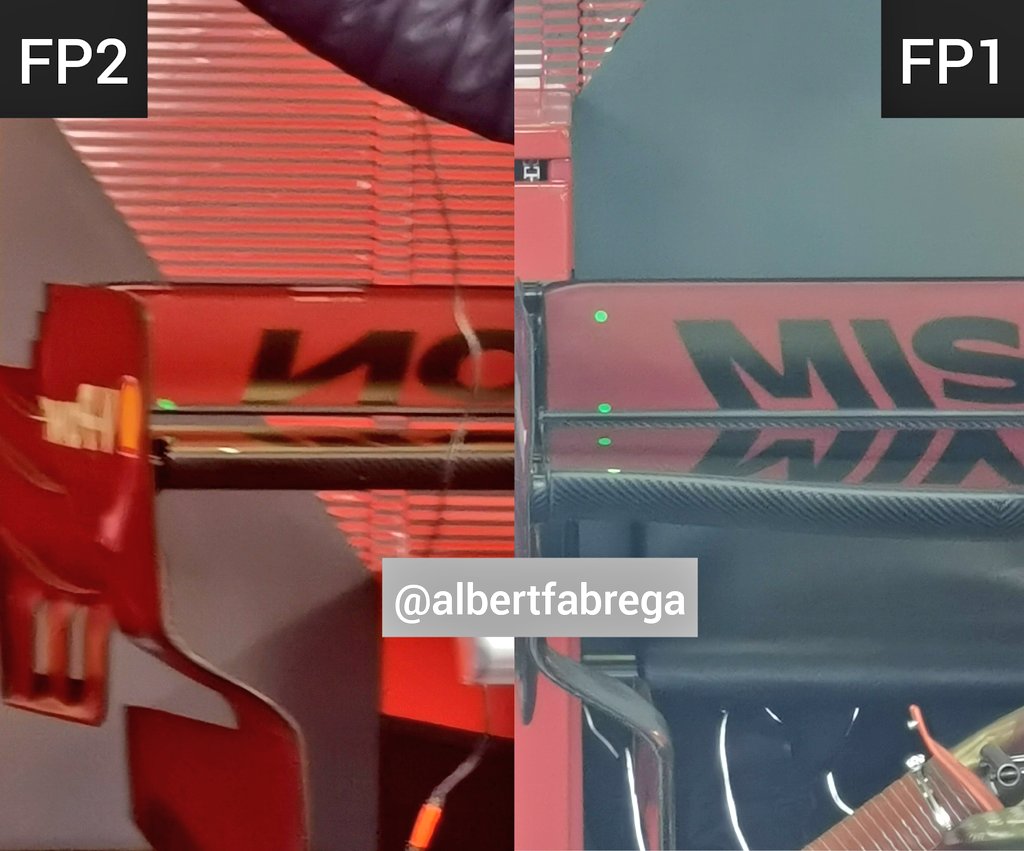
At Ferrari, for example, in FP1 the rear wing with medium aerodynamic load, with a main spoon profile, was tested. A solution that we expected from the Maranello team’s technicians, who historically have adopted the spoon solution on this track. The profile, which becomes more neutral towards the bulkheads, makes it possible to reduce drag without sacrificing too much downforce generated by the rear wing.
On the SF21 we had already seen this solution at Imola, only to be rejected for the most loaded wing due to the rain.
In FP2, on the other hand, the technicians from Maranello decided to use an even lower rear wing on both single-seaters, similar to the one already seen on the SF1000 on more than one occasion last season. Wing with almost neutral main plane that guarantees less drag, favoring a less stretched hybrid use also in terms of racing. Recall that the Ferrari PU currently still pays a certain amount of hp from the top. Also noteworthy for this event is the introduction of a fresh power unit for both Ferrari and Mercedes engines. The only difference for those of the Italian side is the use of a new MGU-K unlike the customer teams.
It will be very interesting to see what choice the engineers will make and, with the data acquired and the feedback from the drivers, they will also confirm it towards qualifying.
Leaving aside the events in Monaco, Ferrari in Azerbaijan could run more defensively than in Spain, with the Azerbaijan GP proving to be an important testing ground for Ferrari’s continuation of the season.
In Baku, where the horsepower deltas between the Power Units are more prominent, the Mclaren-Mercedes could be more at ease than the SF21 especially in race pace, also due to the aerodynamic efficiency of the MCL35M.
On a track over 6 km long, the medium-fast sections are interspersed with important braking, with slow 90-degree corners in which it is important to have precision in insertion and mechanical grip. This leads the teams to search for the right compromise on Friday, comparing wings with different incidence.
It will be important to understand how the behavior of the tires changes with different aerodynamic choices, as an excessively light set-up could create difficulties in wear and in putting the tires in window.
For this GP, Pirelli has decided to introduce the softest compounds of the lot, C5 (soft) – C4 (medium) – C4 (hard). The low abrasive city asphalt of the Baku track meets the needs of those looking for more discharged set-ups. However, quickly putting the tires in the window in the race will play a key role, especially in Baku where the undercut is not irrelevant.
Red Bull for its part manages to generate a lot of downforce deriving from highly efficient aerodynamic parts, such as floor and diffuser. The high rake setup allows the RB16B to unload more ailerons, without losing too much load.
The low-medium load rear wing of the RB16B for the Azerbaijan GP is completely new, both in the profiles and in the endplates. The spoon profile is more unloaded on the sides than the solution of the previous GPs, while the mobile flap of the DRS has been deprived of the nolder and comes in two versions, as well as having a reduced chord. As for the endplate, the design has been practically simplified, with the disappearance of the blowing in the twisted area. A sort of return to a pre-2020 solution, but which allows for a more uniform flow to favor efficiency.
But at Red Bull this year they are not sparing, and updates have been seen practically at every GP, despite the constraint of the budget cap. The fight with Mercedes is open, and Adrian Newey’s car on this track could have some points against the W12.
Mercedes knows it can count on a more powerful and more reliable Power Unit than Honda, even if this year the gap between the two manufacturers seems to have narrowed. The Anglo-German team in Baku must react immediately to the Moanco disaster, and return to the top levels of Spain. The W12 fails to generate all the load that Red Bull offers from the floor and diffuser, also due to a low rake setup.
In Baku the rear wing is heavier than Milton Keynes’s rival. In FP1 Mercedes tested the rear wing used in Portimao by Bottas, medium load, but with the single pylon that reduces the overall dimensions compared to the double support solution.
The rear wing of the W12 for now is more bucking than its rivals, but that helps the black arrow handle the tires better, and be more driveable in slower corners.


Leave a Reply