The Ferrari SF-23 could adapt well to the Las Vegas Strip Circuit. The characteristics of the track should enhance the qualities of the red car, which aims to have a successful weekend in Nevada. The World Constructors’ Championship standings matter little for the Prancing Horse, as finishing second or third won’t make much difference. On the contrary, trailing behind Mercedes will offer some advantages in the available time between wind tunnel testing and CFD analysis in the 2024 racing campaign.
Looking at the layout of the Formula One newcomer on the calendar, we immediately notice that the track is essentially composed of three long high-speed sections interspersed with various types of curves. For a brief visual summary, we can refer to the following image. After the first braking point, there is a medium-slow hairpin taken at high speeds. For this reason, braking will be crucial.
At this point, a stable rear is needed to provide the right grip to generate traction towards turn 2, a section with a very wide radius that will be used to tackle turns 3 and 4 effectively. These two turns can be considered a single portion of the track taken at increasing speeds. A good combination of load and mechanical grip, along with extreme attention during entry due to the proximity of the barriers, is crucial.
After the first straight, we reach turn 5, a 90° right-hand corner with a medium-speed profile, where the cars will need a solid front end combined with a factual aero-mechanical balance. We proceed towards turn 6, which, in terms of curvature radius, is similar to turn 4 in Sochi. In this turn, the tires on the right side of the cars will be heavily stressed.

Following is a low-speed chicane where mechanical grip will dominate. Then on to turn 9, a left-hand corner where the exit will be important considering the subsequent high-speed section. Here, a fast “S” double turn appears where especially the front-end load will play a fundamental role in achieving good lap times, followed by braking, trying not to “knock down” too much speed at the mid-corner.
The exit from this turn will be crucial again as it leads onto the longest straight of the circuit, crossing the famous “Las Vegas Strip.” Turn 13 will be taken flat out without problems. With a strong braking, we arrive at another slow section, a three-apex chicane, similar to the last section of the Miami circuit, where mechanical grip and traction, combined with good agility of the car in direction changes, will be crucial.
There is also an interesting aspect. Teams and drivers will need to understand the height of the curbs scattered along the track. Examining the available images, they don’t seem very high, but if they are at some point, it could be a discriminating factor for the ride height configuration. This is because they will need to try to tackle them in the most aggressive way possible without unsettling the wing car, thus limiting performance.

Show your support for Scuderia Ferrari with official merchandise collection! Click here to enter the F1 online Store and shop securely! And also get your F1 tickets for every race with VIP hospitality and unparalleled insider access. Click here for the best offers to support Charles and Carlos from the track!
GP Las Vegas 2023/Technical Preview: Ferrari SF-23 Puts It to the Test. Aero-Mechanical Compromise for Maximum Performance
From the description just given, we can make some predictions, although a new circuit can always hold surprises. Performance will also depend on the technicians’ ability to adapt the cars to the track. Simulations have been abundant in recent months, spending many hours on the so-called “driver-in-the-loop.” In this way, if the various inputs entered into the computers are sufficiently accurate, the team can have an important indication of which areas to focus on to find maximum competitiveness.
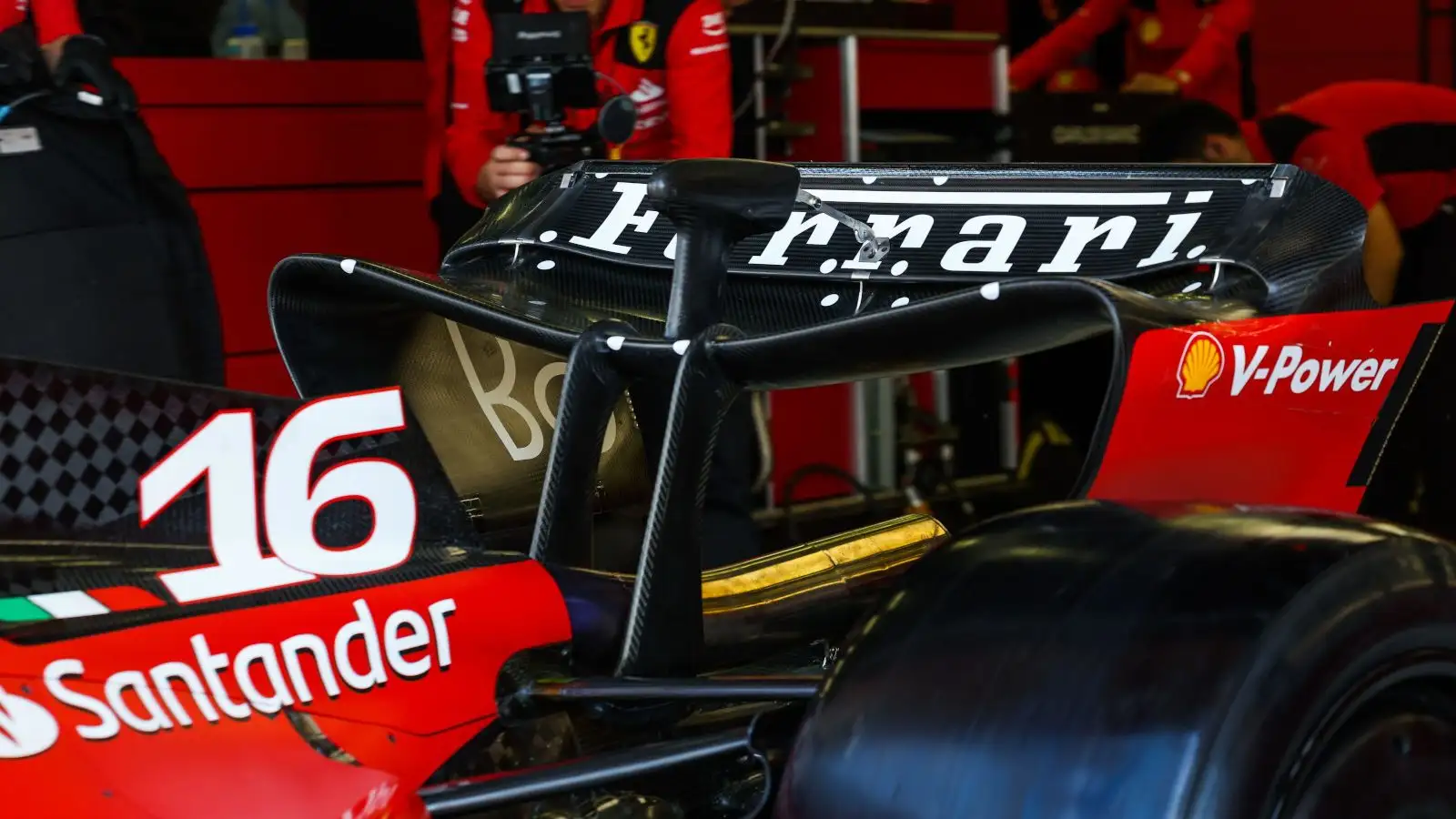
The aerodynamic load adopted should be medium-low, although we await confirmation from the first images of the cars on American soil. This is a setup that the Ferrari SF-23 usually “digests well.” The asphalt seems to be very smooth, considering that the various roads making up the track have been repaved. The absence of bumps will guarantee lower ground clearances, a working range that will favor the red car against Red Bull and McLaren.
In this case, we should see an RB19 with more rear load thanks to the high aerodynamic efficiency it is capable of producing. At the suspension level, despite seeking moderately softer setups, it will be necessary to ensure good responsiveness and precision at the front by choosing the correct stiffness. This is an aspect on which Ferrari will have to focus again to contain understeer, which negatively characterized the 2023 car.
To have a more precise idea of the suspension setup, we can say that we will find less rigid values compared to Bahrain, as the average cornering speed will be lower. The Italian car will try to leverage its qualities in the slower sections, showcasing the excellent traction of the SF-23. However, it remains to be seen whether Ferrari will find a good compromise in other parts of the track, between stiffness and grip, especially at the front, while Red Bull will try to soften the rear to generate more traction during acceleration.
Regarding the weather, very low temperatures are expected, which could give rise to several handling problems. First and foremost, we talk about difficulties in merely activating the tires, especially the front ones, given the lack of high-speed corners in support and the many straights that will tend to cool the Pirelli covers over the lap.
For this simple reason, teams will have to be good at reacting by varying the car setups to provide as much heat as possible to the compounds, hitting and maintaining the correct operating window. There are several methods to do this, from increasing vertical load to suspension geometry. The presence of the tedious phenomenon called graining is also possible, considering that the different tire layers could have different temperatures.
Source: Alessandro Arcari and Niccoló Arnerich for FUnoanalisitecnica


Leave a Reply