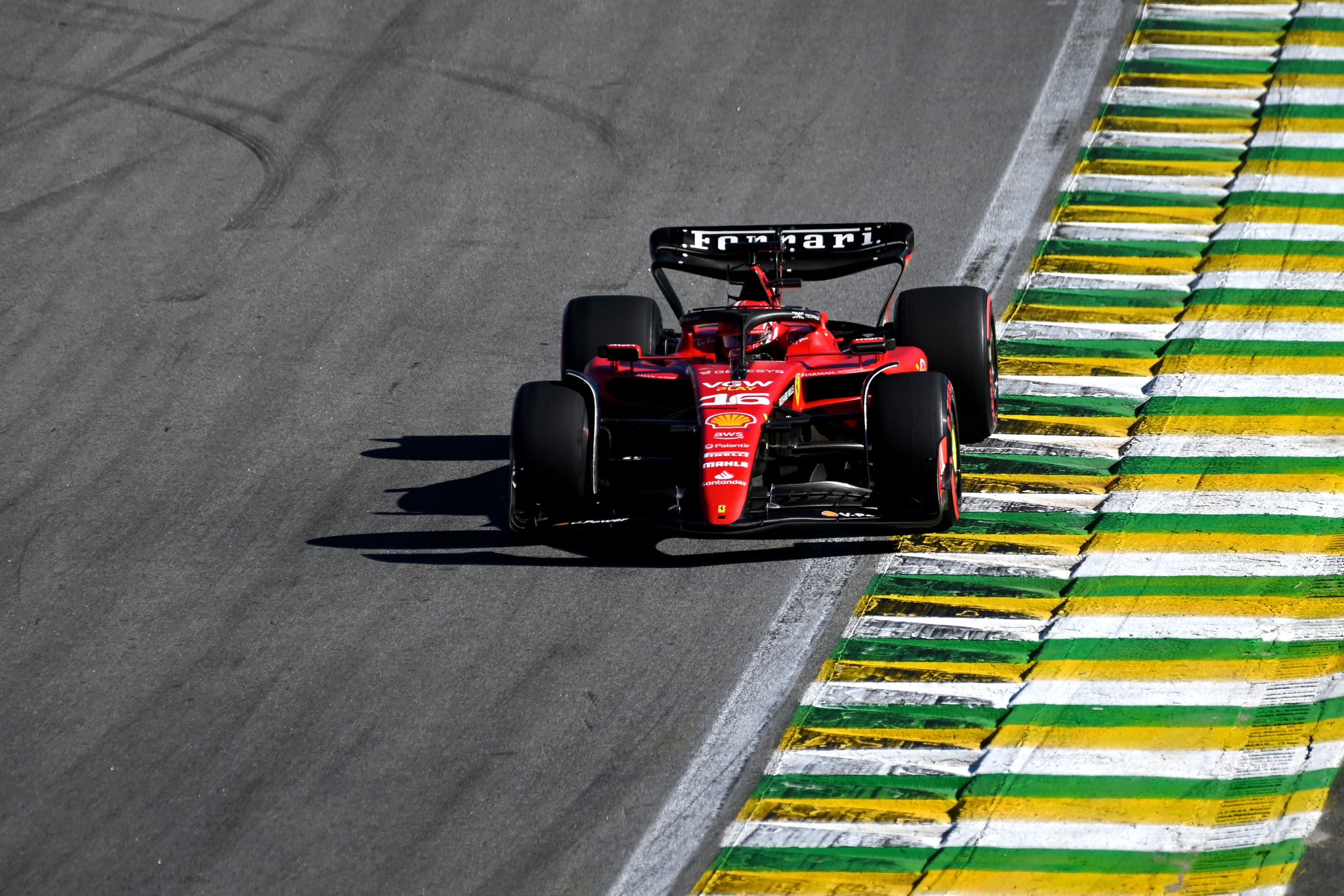
The Ferrari SF-23, a car that chose to “snub” the F1 Sprint from the start. Max Verstappen, on the other hand, wins the 100 km mini-race at the Brazilian Grand Prix. The Dutch talent started in second place alongside Norris but immediately took the lead thanks to an excellent start when the lights went out. The world champion’s reaction time was at the limits of human capability; the clutch disc was released after just 0.15 seconds.
There was little Lando could do as he was immediately overtaken by the Dutchman into Turn 1, undoing his good work from qualifying in just a few meters. Nonetheless, Lando Norris managed to keep up with the pace for 3/5 of the F1 Sprint but experienced a slight tire degradation towards the end. Perez, who secured third place, had a better feeling with his car than he had in a long time.
The performance of the Ferrari cars was more complicated, as stated in the first line of the article. The red cars encountered their usual tire degradation problems, with the Soft tires easily falling out of the usage window. Only in the closing stages did the tires come into the “zone” for the “two Carlos,” allowing the Monegasque to regain a position on Lewis Hamilton.

Brazilian GP 2023/F1 Sprint, Degradation Analysis: Ferrari SF-23 Lowers Lap Time in the Final Stages. No tyre wear issues for RB19.
An analysis of tire degradation shows that Max Verstappen managed to finish the race with better times compared to the first laps without showing wear. Norris, on the other hand, only loses lap time towards the end of the stint, averaging about three-tenths of a second per lap. Sergio Perez didn’t experience any deterioration but consistently lapped one second slower than his teammate.

Source: FUnoanalisitecnica
Managing the SF-23 was more complicated. It can be observed from the graph that the red dots representing Charles’s lap times form a parabola, with the Monegasque driver only regaining lap time in the final part of the stint. The tire management advocated by the Ferrari pit wall allowed for performance during the last laps, but it was probably excessive.

It’s also noticeable that the yellow dots representing Carlos Sainz’s lap times follow a similar pattern to those of his teammate, with a performance recovery in the final part. The final laps were challenging for Lewis Hamilton, who pushed the tires too hard, leading to significant wear after lap 17. Due to excessive overheating, Lewis couldn’t accelerate effectively, losing time on traction.
Show your support for Scuderia Ferrari with official merchandise collection! Click here to enter the F1 online Store and shop securely! And also get your F1 tickets for every race with VIP hospitality and unparalleled insider access. Click here for the best offers to support Charles and Carlos from the track!
Brazilian GP 2023/F1 Sprint, Fuel Saving Analysis: Ferrari SF-23 Saves Fuel to Push in the Final Stages. Norris is the Most Consistent
Let’s shift our focus to fuel management. The points where fuel-saving is maximized are at the ends of the two main straights. The driver with the highest percentage of fuel saved is Lando. The Englishman is consistent, with a peak of 12.3% on the fourth lap. Max Verstappen’s approach is more variable, alternating between aggressive and conservative driving, resulting in an average percentage of around 5%.
The fuel saving by the Ferrari drivers is very similar. The average value hovers around 4%. Carlos Sainz and Charles Leclerc push harder in the early part of the race and go for fuel-saving in the middle. The goal was to take advantage of the accumulated fuel in the final laps.

Source: FUnoanalisitecnica
Sergio Perez makes better use of the extra fuel he started with, allowing him to make a comeback. Mercedes adopts a different strategy: George Russell prefers to start and finish with fuel-saving, pushing during the middle laps. Lewis Hamilton, on the other hand, manages fuel similarly to the Ferrari drivers.
Continuing to examine the evolution of lap times, speed, and fuel, for a brief recap during the Sprint Shootout. The format dedicated to qualifying for the F1 Sprint requires drivers to use two sets of medium tires in Q1 and Q2, and then switch to the softer tire in Q3. Norris managed to achieve better times at each stage. The orange line representing the Englishman’s lap times is consistently lower than that of his competitors. The most surprising data concerns the top speed achieved by the MCL60 with the Medium tires.

Source: FUnoanalisitecnica
We know that top speed isn’t a strong suit of the papaya-colored cars, but in qualifying, they approached that of the Ferrari. Lando managed to deliver a better performance despite having a lower average fuel percentage than his competitors. These considerations allow us to understand that the Woking car has adopted a lighter setup. The graph also shows how high the vertical load on the Mercedes cars is. Hamilton and Russell clearly have the slowest speeds on the straights but manage to exploit the extra load in their use of fuel, with a higher average percentage than others.
Source: Leonardo Pasqual and Alessandro Arcari for FUnoanalisitecnica


Leave a Reply