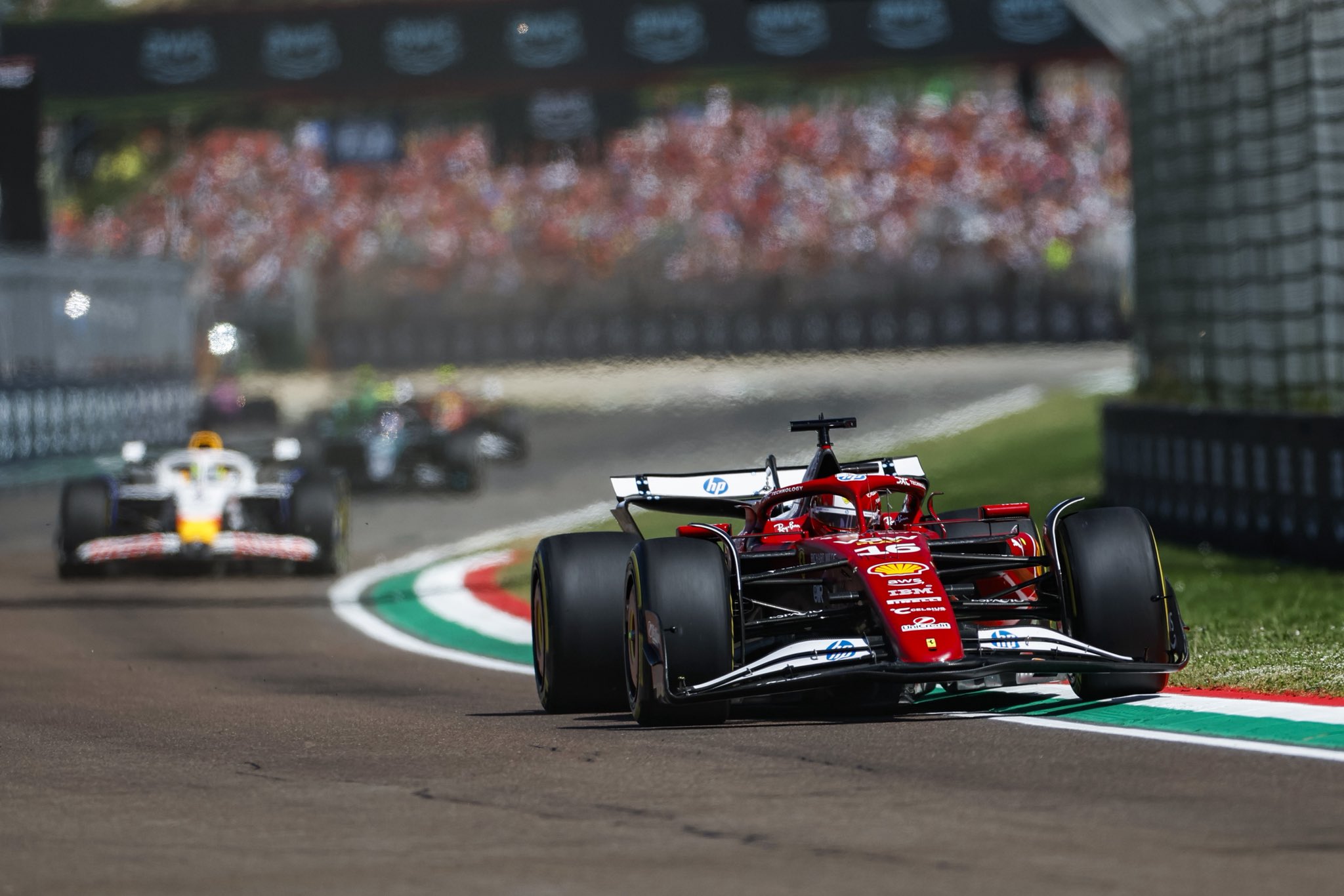
A lion. Once again, Charles Leclerc did not hold back and truly put his heart into a Grand Prix where, in front of the supporters of the Prancing Horse, he wanted to give an emotion to the many fans who came to the stands at Imola to cheer Ferrari on. As often happens, Charles Leclerc went all out hoping to recover positions, and sixth place probably does not do justice to his performance at Imola.
The Prancing Horse decided to vary strategies at the start, having the Monegasque start on the medium tires, the compound chosen by the entire top 10, while Lewis Hamilton started on the hard tires with the aim of extending the first stint and perhaps hoping to run in clean air or benefit from a Safety Car at a favorable moment.
On the tactical side, Ferrari’s strategists read the race perfectly, exploiting Russell’s slow pace in the first stint, who at that stage was keeping the pack tight, to pit Leclerc and overtake four cars in the pits with an undercut, including the Mercedes driver.
The pit stop, made early after only ten laps, effectively cemented his race on two stops but allowed him, within a few laps, to pass several rivals, including Carlos Sainz’s Williams and the two Aston Martins, who would have been difficult to overtake on track. An effective strategy, but one that had to contend with two elements.

Before the race, there was some uncertainty about what the winning tactic might be: on paper, two stops seemed the fastest option, but the time lost in the pit lane as well as traffic on track favored a one-stop strategy. The longer the race went on, the more the tires proved they could hold up, benefiting those on a one-stop plan.
However, the Virtual Safety Car about halfway through the race complicated things further for those on two-stop strategies, because the race was neutralized quite early compared to an ideal situation, forcing Leclerc to fit his second set of hard tires earlier than planned. Also, those ahead could pit later and save several seconds, which really makes a difference on one of the longest pit lanes in the world.
“I know I put my heart into it, I know I gave it my all, but that’s how it is. We had two Safety Cars that came at the worst times,” Leclerc explained to Sky after the race, adding that he could not pit during the second Safety Car, the one for Kimi Antonelli’s problem, so he had to stay out on tires that were already nearly 20 laps old.

“The second [SC] we couldn’t even take advantage of because there were only soft tires available. In the end, I wanted to go put on softs, but Lewis changed his mind and went to the pits. So I didn’t know how many positions I would lose if I pitted just behind him because I would have lost time.”
Initially, they also considered fitting soft tires, but there were still many laps to the finish. Although the tires had shown good durability, the C6 compound would probably have suffered a rapid thermal drop, as already seen on Friday. It’s true the car would have been lighter, but the track was quite hot.
“So I told myself: I won’t take risks, I’ll save what I can, and we’ll see after the VSC. As I expected, it was impossible to keep them behind. I did everything, I was really on the limit, but in the end, I have no regrets because I think I may have even helped Lewis a bit, and from my side, I tried until the end.”
In the final stages, the Ferrari driver was involved in a long defense against Albon, who was on fresh tires. In a corner, Leclerc went wide, pushing the Williams driver off the track. The team radio instructed him to give the position back to avoid a penalty that would have dropped him further down the standings: a decisive choice, because the stewards imposed no sanction precisely because Leclerc yielded the position before the finish line.
Looking more broadly, Charles Leclerc also analyzed Ferrari’s current moment from a global perspective. One poor race does not erase the difficulties experienced yesterday in qualifying, where the SF-25 still needs to improve if the goal is to get closer to the top rivals and, above all, not always have to race from behind.
“I completely understand this kind of question, because even I, when I look at what we say every time we come in front of the camera, it’s that we have to understand. Unfortunately, I think that’s a bit the case in Formula 1. We always have to understand, so maybe it’s always the same words,” Leclerc explained, adding that although the engineers are pushing and testing many solutions, there is still no definitive one.
Just after qualifying, Charles Leclerc himself said that to save the SF-25 project, a big step forward was needed and that it was not certain it would come with the upgrade package expected to debut in Barcelona, together with the directive that will impose stricter criteria on wing flexibility.
“To have a reaction, it’s not like we can say we make this part but we don’t know why, we don’t know where we’re going, it doesn’t work like that, so we have to understand the root of the problem. It’s not like we don’t understand anything that’s happening. There are signals, we’re trying many things on the simulator, but for now, we haven’t found the solution yet and we’re working on it.”
However, Charles Leclerc stressed that trust in the team does not waver despite a season start that, as admitted by Frédéric Vasseur, has been below expectations. “I have trust, everyone has to have it, and we have to push until the end. That’s what I’ll do, I’m doing my best, and I hope it will pay off in the end.”


Leave a Reply