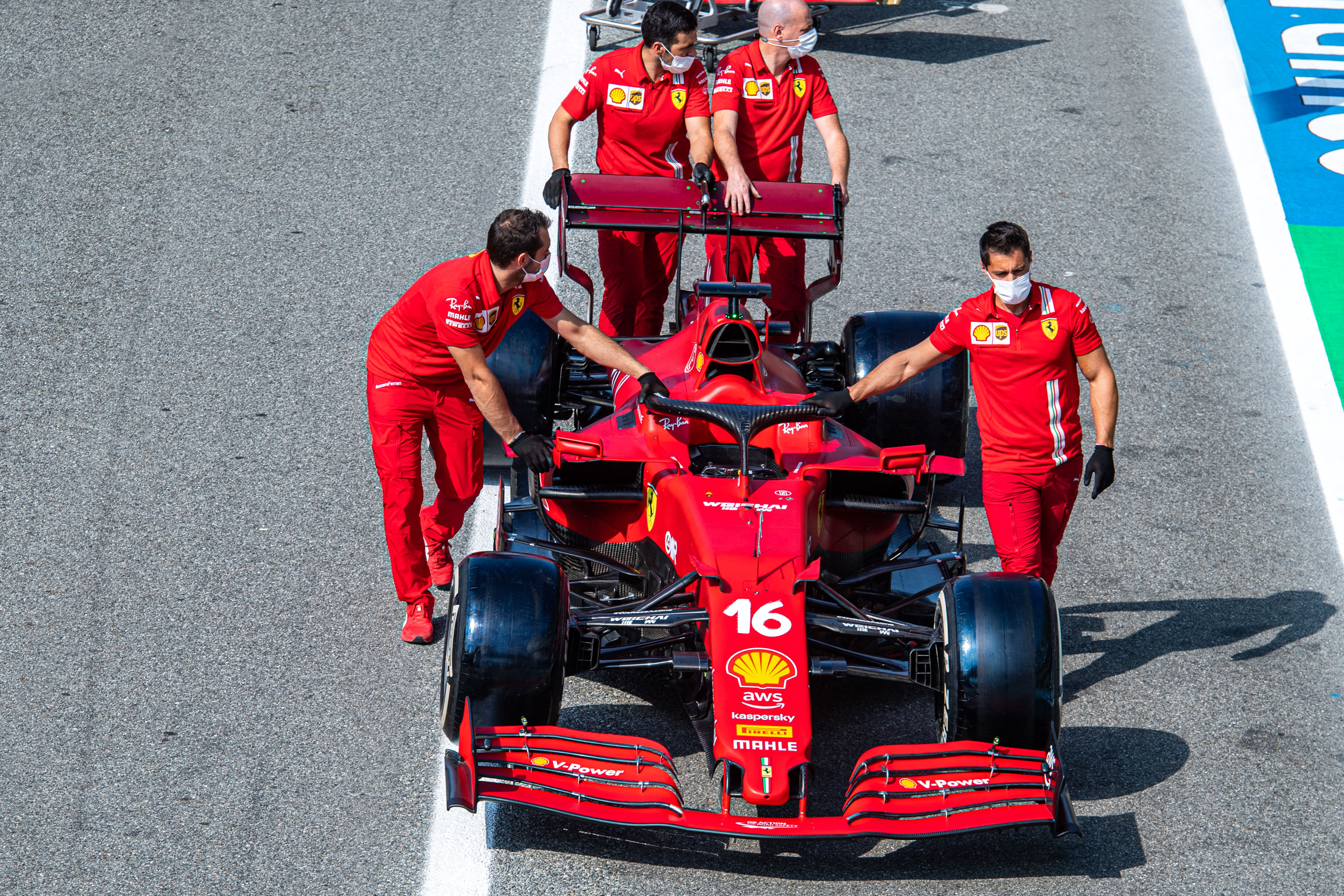
After having to run last year’s Italian Grand Prix without fans, thousands of tifosi are now expected to descend on the Temple of Speed for Scuderia Ferrari’s home race. For Charles Leclerc, returning to the Maranello team’s home circuit has already been an unrivalled experience, while for teammate Carlos Sainz it has been a “crazy” first appearance in Scuderia red in front of the Italian fans.
Charles Leclerc took his second Grand Prix victory at Monza two years ago, triggering wild scenes of celebration from the fanatical Italian fans. The race had to run behind closed doors last year, but this weekend the fans are back, and the Monegasque can’t wait to perform in front of them.
But Ferrari is aware it will be difficult for them to challenge for something more than a points finish given the track characteristics and the SF21’s performance. Let’s take a look at Ferrari’s mechanical and aerodynamic set-up for Monza, as presented by funoanalisitecnica.com:
Formula 1 cars with more powerful engines will certainly enjoy a big advantage at Monza. However, the story certainly does not end here: the research work on the mechanical and aerodynamic set-up, elements that must necessarily match perfectly to guarantee the maximum performance of the car, is in fact much more complex than what one might trivially think.

On a track where most of the lap time is spent on the straights, unloading the wings means lowering the resistance to progress but at the same time losing downforce. Crucial element in certain areas of the circuit. To find the right compromise, therefore, it is necessary to recover part of the lost grip by generating a load which, with the same vertical thrust, affects aerodynamic penetration in less quantity.
We are therefore talking about optimizing the entire floor of the car and the diffuser. These elements, in fact, are capable of producing downforce without dramatically increasing drag. This is one aspect which Red Bull has mastered, often able to use a much lighter rear wing when compared to its competitors thanks to the vertical thrust produced by the car body of the excellent RB16B.
There is another very important weapon that used wisely can increase the performance of the car on the Italian circuit: the mechanical grip. On tracks like Monza the suspension system can create a big headache for engineers. Bearing in mind the different and crucial changes of direction on the Italian track, the front definitely needs tougher anti-roll bars. On the contrary, a softer rear end can undoubtedly favor traction out of the variants.

In addition to this, one more thing should be taken into consideration: on some single-seaters, a more rigid suspension element is a must to keep the aerodynamic platform stable. This is because some components may “not like” the greater height travel that occurs when using the softer spring-shock absorber combo. A not indifferent limit that one must think about.
In the specific case of Ferrari, at an aerodynamic level, we can think about the development of Belgium. Although Spa-Francorchamps has undoubtedly different characteristics, in various respects the wonderful track set in the woods of the Ardennes has some similarities with the Italian one. The high-speed areas of the Belgian track, in fact, require a set up very similar to that of the Brianza circuit where the outwash effect will be fundamental. The intention is to push the air flows outwards to remove the vortices produced by the rolling of the front tire from the car.
It must be said that although this phenomenon is generated by the front wing, much of this work is done by the entire bargeboard complex. The perfect correlation between each of these elements designed to push the flow outwards must act in complete synergy. On the contrary, the turbulence could easily be sucked from the floor and, consequently, a decrease in the rear vertical thrust of the car would be obtained.
As we can see thanks to the very first images of F1 comentator and analyst Albert Fabrega, arriving directly from the Italian pit lane, the rope of the last flap of the front wing has been reduced to adapt the amount of load expressed to the needs of the Italian track. Compared to Belgium, however, where the cut was in the central part, at Monza the Maranello technicians decided to unload the outer area of the wing more. The purpose is to emphasize the aforementioned outwash effect.
Ultimately we look at the most important factor of all that can heavily impact vehicle performance: the balance, without which the confidence in the driver is lacking. As mentioned, the Maranello technicians worked a lot on the simulator. The aim is to be on the track on Friday morning with a center of aerodynamic pressure close to that of gravity.
This is to avoid absolutely unnecessary and very harmful phenomena such as oversteer or understeer. The goal of the Monza tuning is to provide the correct rear load to ensure adequate traction, which is essential when exiting slow corners. But at the same time the car must have a sufficient amount of downforce at the front to guarantee stability in the sudden braking of Monza.


Leave a Reply