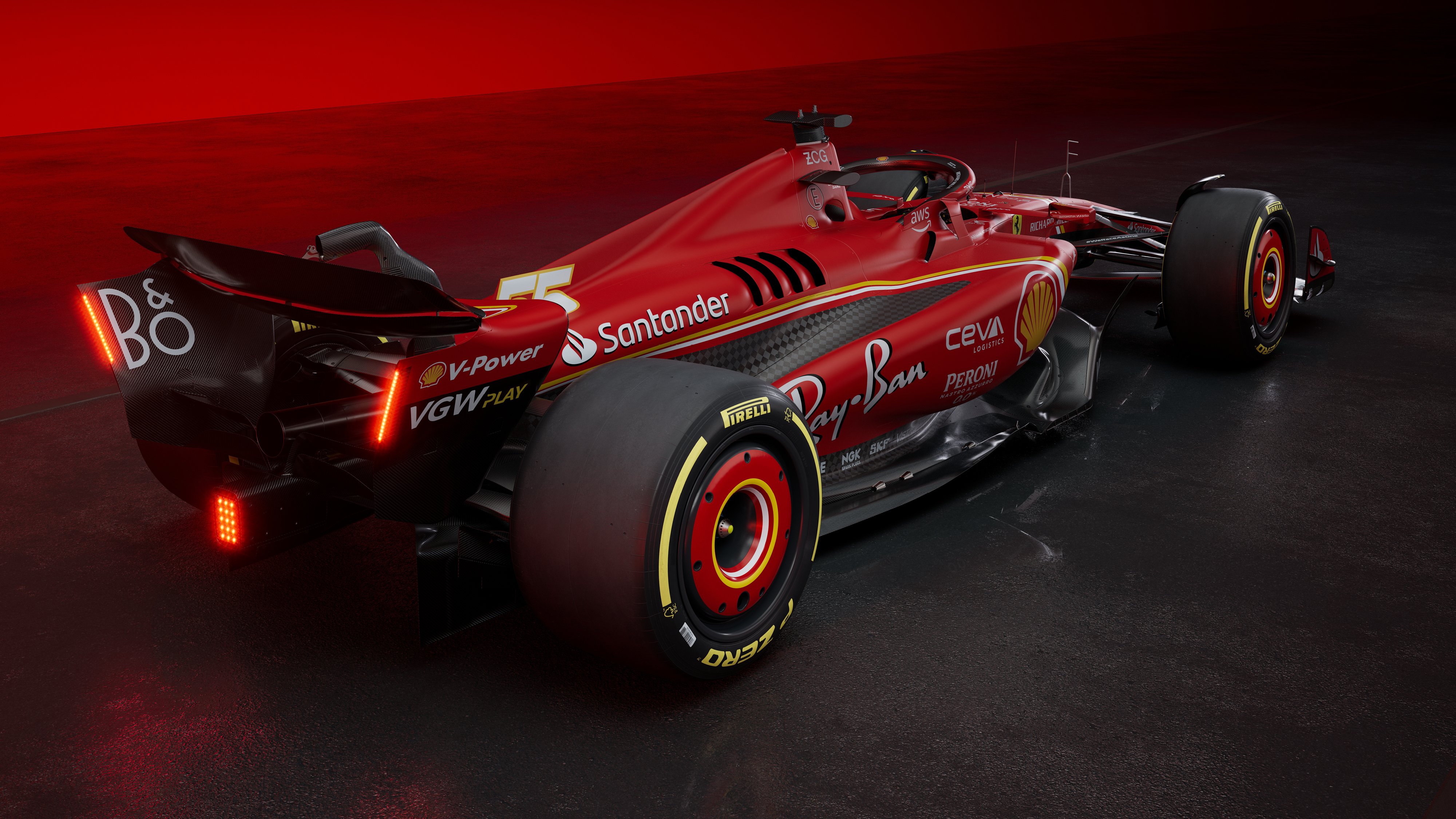
The most awaited moment by many fans of the red team has arrived. Ferrari has unveiled the SF-24, and a quick visual analysis is enough to understand how different it is from last year’s car. In Maranello, they have completely revolutionized some concepts to adopt a philosophy more in line with Red Bull. However, Ferrari has not only limited itself to “copying” but has also maintained distinctive technical choices.
New chassis and revamped sidepods
Ferrari has completely changed the geometry of the sidepods on the SF-24. First of all, there is a reduced inlet from which the tray for separating flows originates. This creates a clear distinction between the flow directed towards the radiators and that towards the car’s bottom.
Thanks to the new chassis, the intrusion cone, a limitation for the SF-23’s development, finally disappears and is now integrated into the bottom. This modification allows for a broader but not extreme undertray, as seen on other teams. This results in better feeding of the upper part of the car’s bottom and the consequent gain in efficiency.
The upper part of the sidepods is very interesting. The principle is still downwash, but now there is a basin in the innermost part. The goal is to bring as much air as possible towards the rear. However, Ferrari has chosen to differentiate itself from other teams and proposes a different concept in the sidepods.

Suspension analysis SF-24, Ferrari unique with rear pull rod
Unlike other teams, Ferrari has chosen to remain faithful to its suspension schemes. At the front, we find a push-rod system, while at the rear, there is a pull-rod system. The SF-24 remains the only one on the grid, along with Haas, which buys from Ferrari, to adopt the solution with the pull rod at the rear.
However, Maranello’s technicians have intervened on the geometry of the attachments. The upper triangles are now more inclined to ensure the anti-dive effect at the front and anti-squat at the rear. This way, Ferrari will have a much more stable platform. These geometries limit load transfers during braking and acceleration. Another one of the major issues with the SF-23 should, therefore, be resolved.
New engine cover
Ferrari has completely revised the engine cover on the new car. The specific tight design seen last year disappears. In its place is a solution derived from Red Bull. We find a flat “tray” at the rear of the cover with a large opening around the exhaust. This variation affects how the air interacts with the rear wing and the beam wing. This design seems to ensure better aerodynamic efficiency. Under the chassis, we find a shorter gearbox that is part of all the work done at the rear.

The air scoop is different from what was seen on Haas and Sauber, here triangular in shape. Ferrari has managed, thanks to the new chassis, to arrange the radiating masses differently. However, the new sidepod geometry has forced some changes. In Maranello, they have indeed changed the position of some radiators and electrical components. This is also to seek a different weight distribution and thus better tire management.
Revised front wing
Ferrari has also intervened in the design of the front wing. As already seen on Haas, the philosophy is similar to Red Bull’s. The flaps, therefore, show a clear outwash effect to seek greater efficiency by reducing drag. The nose seems to be shorter and attaches to the second-to-last element of the wing.
Ferrari has decided to draw inspiration from other philosophies but not to make a copy. The SF-24 maintains its own distinct identity.
This initial analysis of the Ferrari SF-24 highlights how much work has been done in Maranello during the winter. The goal is to overcome all the limitations of the previous car. From the statements gathered, there seems to be confidence in this new project. The anticipation for the pre-season testing session in Bahrain is at its peak. Only there will we see the true potential of the SF-24 single-seater.
Source: f1ingenerale


Leave a Reply