The first Ferrari car entirely designed under the leadership of Fred Vasseur and his team continues to take shape. After the failed SF23 project, Mattia Binotto‘s last gift before resigning in December 2022, the new red car will be expected to make a significant performance leap next year. However, keeping a low profile and avoiding grand proclamations remains imperative about a month and a half before the start of the championship.
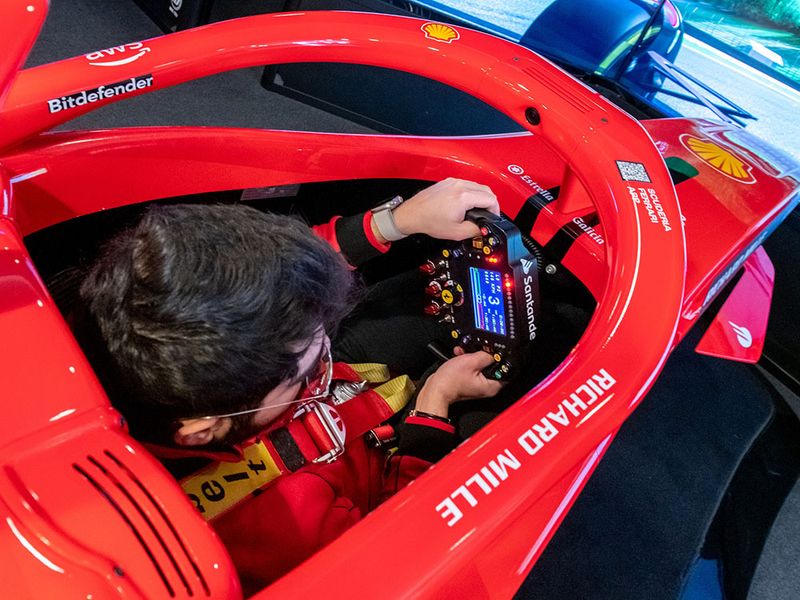
According to some rumors, Ferrari has already found a margin of over 7 tenths in the simulator between the SF23 and the 2024 car, along with 30 points of downforce compared to the specification introduced in Japan. This rumor has immediately sparked enthusiasm among fans but has also attracted many typical comments about the media’s eagerness to outdo each other in making bold statements about the new prancing horse project. The truth, as always, lies somewhere in between.
The 676 is more than 7 tenths faster than the SF23, but no grand claims
“At the moment, the F2024, or whatever it will be called, in simulations shows something like seven-tenths of improvement compared to the end-of-season SF-23, which was not bad at all,” was reported in the columns of the Corriere dello Sport a few days ago.
However, to immediately temper the enthusiasm, Gianluca Gasperini, in a recent article published in the Gazzetta dello Sport, commented, “The 7 tenths gained on average per lap in the simulator – as hypothesized – are nothing sensational and should not deceive.”

“From what is heard elsewhere, compared to the car from the previous season, they have improved by at least half a second, and they are not satisfied with it.”
A thesis we entirely agree with, reviving the usual discussion: the performance improvement must also be measured against how much others improve. It is easy to go from being the winter champion to the beating seen in Bahrain just twelve months ago when engineers immediately realized that the 675 project, compared to the competition, would be a failure.
Improving by several tenths between the end of the previous season and the beginning of the next is undoubtedly possible. Consider the three-year period 2017-2018-2019 when, with the same regulatory stability, Lewis Hamilton lowered the pole time in Australia by a full second in 2018 and another seven-tenths in 2019.

Show your support for Scuderia Ferrari with official merchandise collection! Click here to enter the F1 online Store and shop securely! And also get your F1 tickets for every race with VIP hospitality and unparalleled insider access. Click here for the best offers to support Charles and Carlos from the track!
Now, let’s move on to the second point: do the media always try to portray Ferrari as the best in class in winter? Leo Turrini helps answer this question, who commented on the development of the SF1000 at the beginning of 2020: “At the moment, it seems that the indications from the simulator and the wind tunnel are not exciting the engineers.”
That car, indeed, turned out to be one of the worst projects ever undertaken by the Maranello team, with a heavy handicap on the Power Unit due to the infamous secret agreement related to the previous season that dashed the hopes of drivers and technicians.
As always, all rumors should be taken with a grain of salt, and they can be either false or real until proven otherwise. The contrary proof, regarding Ferrari’s alleged improvement, will only come on the Bahrain track at the end of February, if at all.
Source: f1ingenerale


Leave a Reply